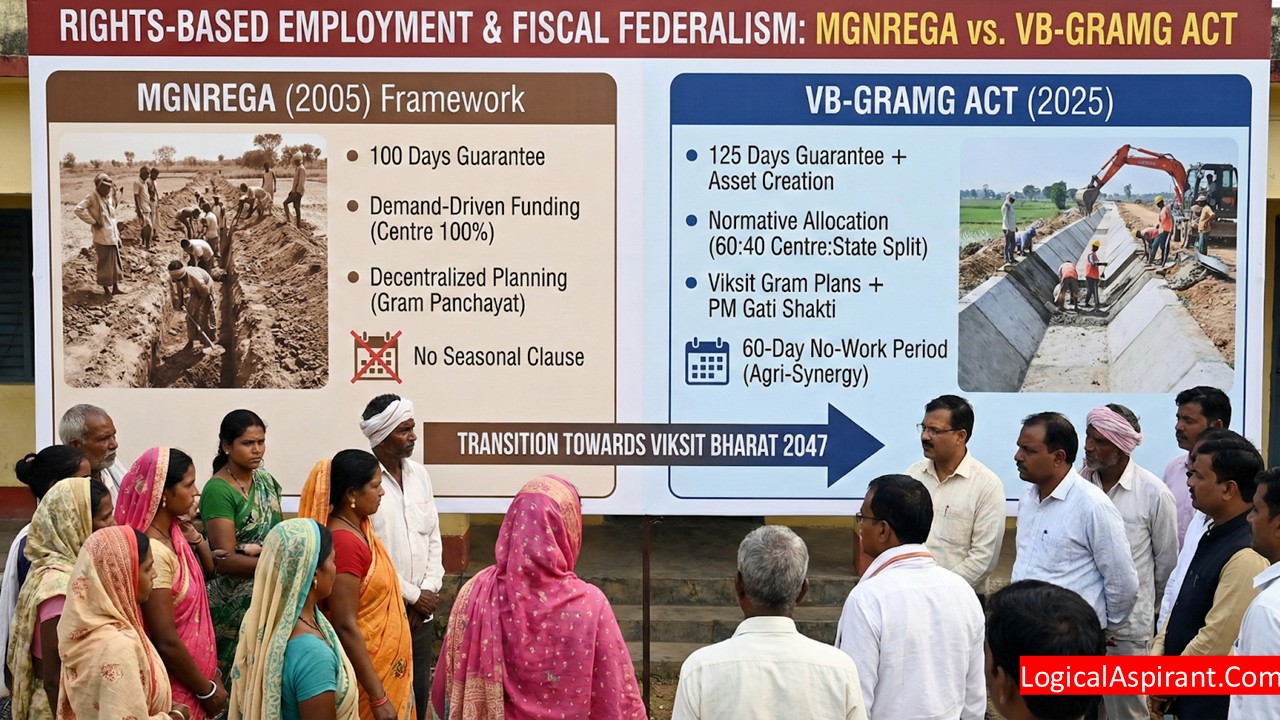
The President of India has granted assent to the Viksit Bharat-Guarantee for Rozgar and Ajeevika Mission (Gramin) (VB-G RAM G) Act, 2025, which repeals and replaces the MGNREGA, 2005. This new legislation increases the guaranteed employment to 125 days per household annually and restructures the financial architecture into a Centrally Sponsored model with mandatory state cost-sharing.¹ As a UPSC aspirant you need to understand the difference between MGNREGA and VB-G RAM G Act, 2025.
Rights-Based Employment & Fiscal Federalism
The VB-G RAM G Act retains the “Right to Work” legal framework but alters the operational and financial mechanism to align with Viksit Bharat 2047 goals.
- Statutory Guarantee: The Act creates a legal entitlement for rural households to receive wage employment. Unlike the previous 100-day limit, the new Act guarantees 125 days of unskilled manual work per financial year.¹
- Asset-First Approach: The focus shifts from merely providing wages to creating tangible assets aggregated under the Viksit Bharat National Rural Infrastructure Stack.
- Fiscal Restructuring: The mechanism transforms from a primarily demand-driven central funding model to a Centrally Sponsored Scheme (CSS) structure. This introduces a “Normative Allocation Framework” where funds are allocated based on fixed norms rather than open-ended demand, aimed at fiscal discipline.¹
- Agricultural Synergy: To address the shortage of farm labor during peak seasons (a frequent criticism of MGNREGA), the Act introduces a mandatory “No-Work Period” to ensure labor availability for sowing and harvesting.¹
Comparison between MGNREGA and VB-G RAM G Act
The transition from MGNREGA to VB-G RAM G involves specific structural changes.
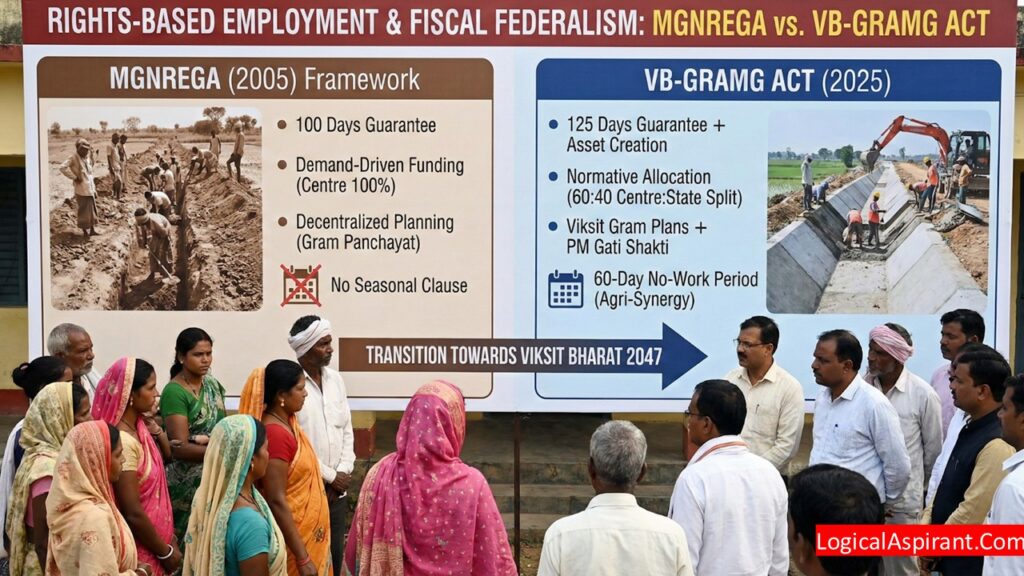
| Parameter | MGNREGA (2005) Framework | VB-G RAM G Act (2025) |
| Guaranteed Days | 100 days per household/year. | 125 days per household/year.¹ |
| Seasonal Clause | No specific mandate on stopping work. | 60-day aggregated “No-Work Period” to release labor for agriculture (harvest/sowing).¹ |
| Funding Pattern | Centre bore 100% of wage cost (Virtual Central Sector character). | 60:40 (Centre:State) standard split. 90:10 for NE/Himalayan states; 100% for UTs.¹ |
| Administrative expenditure ceiling | 6% of total expenditure. | 9% of total expenditure (to improve staffing/technical capacity).¹ |
| Wage Payment | Within 15 days. | Weekly basis, or strictly within a fortnight (15 days).¹ |
| Unemployment Allowance | Liability of State Govt. | Liability of State Govt (payable if work not provided after 15 days).¹ |
| Planning Unit | Gram Panchayat (Decentralized). | Viksit Gram Panchayat Plans integrated with PM Gati Shakti. |
Key Priority Verticals for Works
- Water security through water-related works
- Core-rural infrastructure
- Livelihood- related infrastructure
- Special works to mitigate extreme weather events
The VB-G RAM G Act strengthens the rights-based employment framework by expanding guaranteed workdays while shifting the focus from short-term wage support to long-term rural asset creation.
Sources : 1. PIB Delhi - Explainer: Rural Prosperity Viksit Bharat- G RAM G Act 2025 - [Official Release ID: 156634]