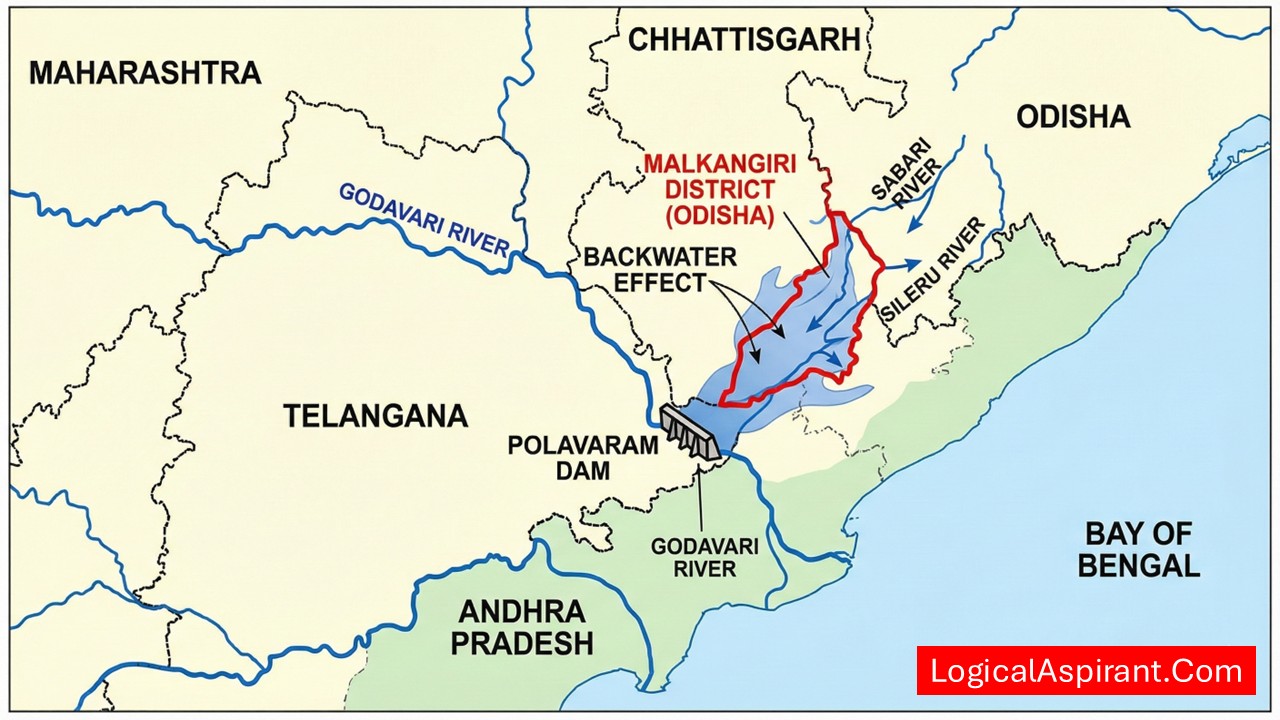
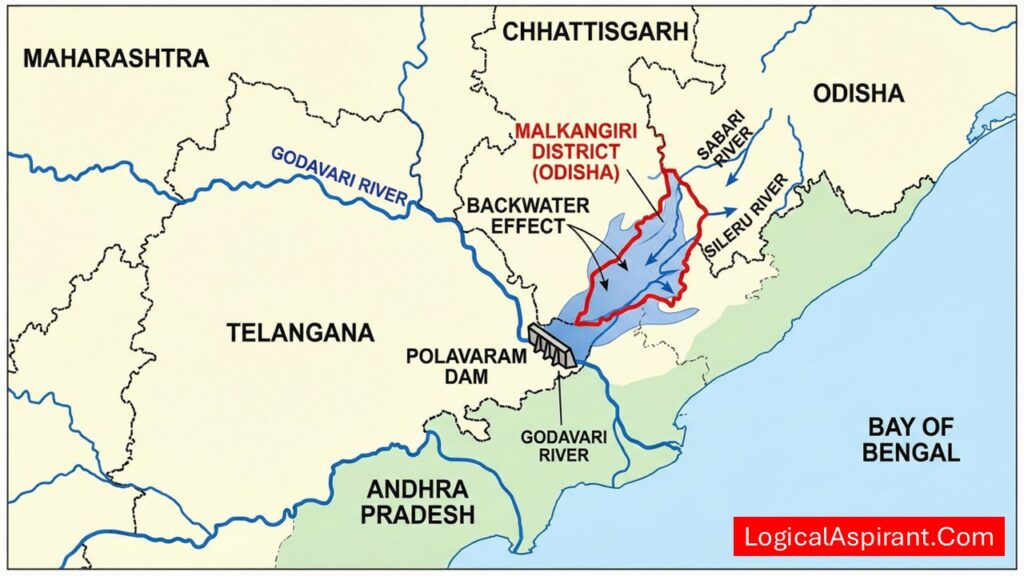
Plovaram project has been in news because opposition party BJD has warned of protests if the interests of Particularly Vulnerable Tribal Groups (PVTGs) in Odisha’s Malkangiri district are compromised by the Polavaram irrigation project. The core allegation is that the project’s revised parameters (increasing flood discharge capacity) lack valid environmental clearances and threaten to submerge tribal habitats.
Here it is important to know about core concepts of this news from UPSC CSE point of view, which are –
- Particularly Vulnerable Tribal Groups (PVTGs)
- Environmental Impact Assessment (EIA)
- Inter-State River Water Disputes.
Particularly Vulnerable Tribal Groups (PVTGs)
While all Scheduled Tribes (STs) face some degree of exclusion, PVTGs are the most vulnerable among them.
- In 1973, the Dhebar Commission created a separate category called “Primitive Tribal Groups” (PTGs). This was renamed to PVTGs in 2006.
- The Ministry of Tribal Affairs uses four specific traits to identify them:
- Pre-agricultural level of technology (e.g., hunting/gathering or shifting cultivation).
- Stagnant or declining population.
- Extremely low literacy.
- Subsistence level of economy.
- There are 75 notified PVTGs spread across 18 states and 1 Union Territory (Andaman & Nicobar).
- Odisha has the highest number of PVTGs (13 groups). In the context of the Polavaram news, the Bonda and Didayi tribes of Malkangiri are the specific groups at risk of displacement.
- PVTGs have a special provision under Forest Rights Act (FRA), 2006. Section 3(1)(e) recognizes “Habitat Rights” for PVTGs, which is broader than individual land titles. It covers their entire customary territory. Habitat Rights under FRA are exclusive to PVTGs. Other STs get individual or community forest rights.
- Who declares PVTGs? – You may think it is the President (like for STs under Art 342). PVTGs (Particularly Vulnerable Tribal Groups) are not a Constitutional category. They are a government classification created through policy/schemes, unlike Scheduled Tribes (STs), which are recognized under Articles 342 of the Constitution of India.
- The PVTG list is maintained by the Ministry of Tribal Affairs, and inclusion happens based on proposals from State Governments/UTs, followed by central approval.
Environmental Clearance (EIA Process)
The Polavaram controversy centres on the lack of “valid environmental clearance” for revised parameters.
- EIA is governed by the EIA Notification, 2006, issued under the Environment (Protection) Act, 1986.
- Projects are divided into Category A and Category B.
- Category A: Requires clearance from the Central Government (MoEFCC). Large River Valley Projects (like Polavaram) fall here.
- Category B: Requires clearance from the State level (SEIAA).
- For Category A projects, a public hearing in the affected area is mandatory (with few exceptions). The BJD argues that when the project’s flood discharge capacity was revised (expanded), a fresh public hearing was skipped in Odisha, violating the process.
- The Polavaram project parameters (height, discharge) are bound by the Godavari Water Disputes Tribunal (GWDT) award. Any unilateral change by one state (Andhra Pradesh) affecting another (Odisha/Chhattisgarh) violates the tribunal’s award.
Direct MCQS Important for UPSC Prelims:
- Q: Which committee recommended the creation of Primitive Tribal Groups (PVTGs)?
(A) Xaxa Committee
(B) Bhuria Committee
(C) Dhebar Commission
(D) Lokur Committee.
Answer – (C) Dhebar Commission - Q: Consider the following tribes:
1. Bonda
2. Chenchu
3. Didayi.
Which of these are PVTGs found in Odisha?
Answer – Bonda and Didayi. Chenchu is primarily in Andhra/Telangana - Statement: “The Environmental Impact Assessment (EIA) for River Valley Projects is optional if the project is declared a National Project.”
False. National Project status is financial; it does not exempt the project from the Environment Protection Act or EIA norms.