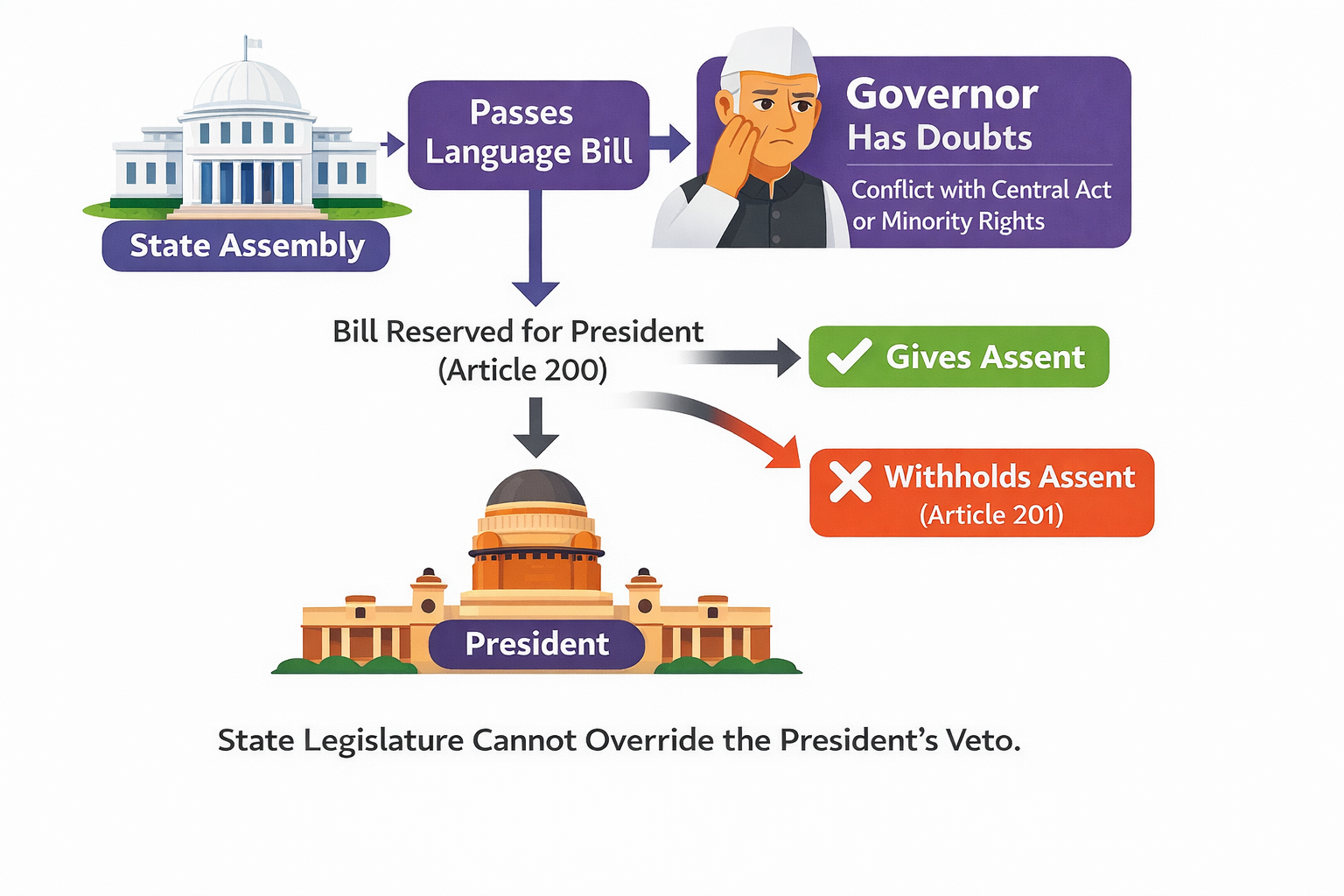
Kerala Legislative Assembly recently passed the Malayalam Language Bill, 2025, mandating Malayalam as the official language for government, judiciary, and education. However, the Karnataka government has urged the Kerala Governor to reject the Bill, citing “unconstitutional” impacts on the Kannada-speaking linguistic minority in the border district of Kasaragod.
Official Language of a State (Article 345)
The Constitution does not specify the official language for different States. Instead, Article 345 empowers the State Legislature to adopt by law:
- Any one or more of the languages in use in the State, or
- Hindi,as the language to be used for all or any of the official purposes of that State. ¹
- Until the State Legislature provides otherwise by law, the English language shall continue to be used for official purposes within the State. ¹
Safeguards for Linguistic Minorities (Articles 350A & 350B)
The 7th Constitutional Amendment Act of 1956 inserted two specific articles to protect linguistic minorities:
- Article 350A (Instruction in Mother Tongue): It requires every State and local authority to endeavor to provide adequate facilities for instruction in the mother tongue at the primary stage of education to children belonging to linguistic minority groups. ²
- Article 350B (Special Officer): It mandates the appointment of a Special Officer for Linguistic Minorities by the President of India. It is the duty of this officer to investigate all matters relating to safeguards provided for linguistic minorities and report to the President. ²
Governor’s Power to Reserve a Bill (Article 200)
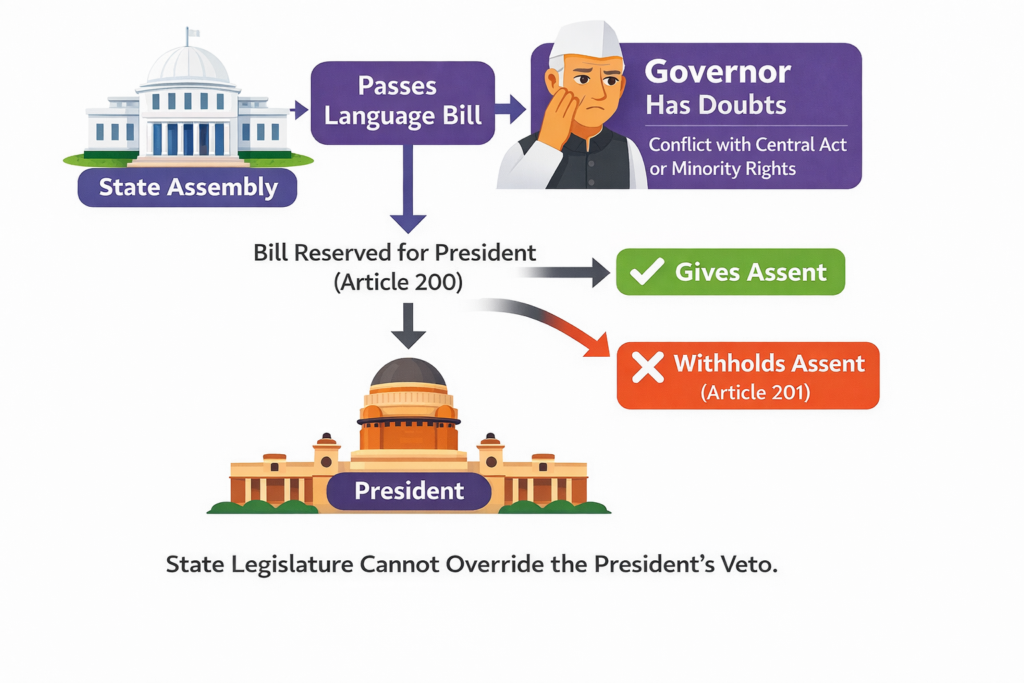
When a Bill is passed by the State Legislature, the Governor has four options under Article 200:
- Give assent.
- Withhold assent.
- Return the Bill (if not a Money Bill) for reconsideration.
- Reserve the Bill for the consideration of the President. ³
- Mandatory Reservation: The Governor must reserve the Bill if it derogates the powers of the High Court so as to endanger its constitutional position. ³
- The Governor may also reserve a Bill if it is against the Constitution, or deals with compulsory acquisition of property under Article 31A.
| Feature | Constitutional Provision | Key Authority |
| Official Language of Union | Article 343: Hindi in Devanagari script. | Parliament |
| Official Language of State | Article 345: Any language in use in the State or Hindi. | State Legislature |
| Recognition of Minority Language | Article 347: If a substantial proportion of the population desires, the President may direct a language to be officially recognized in that State. ¹ | President (Not Governor) |
| Inter-State Communication | Article 346: The official language of the Union (currently Hindi/English) acts as the link language. | Union/State Agreement |
Commissioner for Linguistic Minorities (Specific Safeguard)
- Appointed by President.
- Submits reports to the President, who causes them to be laid before each House of Parliament and sent to the concerned State Governments. ²
- Falls under the Ministry of Minority Affairs.
Remember
- Article 345 allows a State to adopt any language “in use in the State.” It is not restricted to the 22 languages listed in the Eighth Schedule.
- The Constitution does not declare any language as the National Language. Hindi is the “Official Language of the Union” (Article 343).
MCQS relevant for UPSC CSE Prelims
Q1. With reference to the Official Language of a State in India, consider the following statements:
1. The State Legislature is constitutionally bound to adopt one of the languages listed in the Eighth Schedule as its official language.
2. If a State Legislature does not adopt an official language, English continues to be the language for official purposes in that State.
3.The President of India can direct a State to officially recognize a language spoken by a substantial proportion of its population
Which of the statements given above is/are correct?
(a) 1 only
(b) 2 and 3 only
(c) 1 and 3 only
(d) 1, 2 and 3
Correct Answer: (b) Statement 1 is incorrect because Article 345 allows the adoption of “any one or more of the languages in use in the State,” not just Eighth Schedule languages. Statements 2 and 3 are correct under Article 345 and Article 347 respectively.
Q2. The ‘Special Officer for Linguistic Minorities’ in India is appointed under which Article of the Constitution?
(a) Article 340
(b) Article 338
(c) Article 350B
(d) Article 29
Correct Answer: (c) Article 350B (inserted by the 7th Amendment, 1956) mandates the appointment of a Special Officer for Linguistic Minorities by the President.
Q3. Under Article 200 of the Constitution, the Governor of a State is mandatorily required to reserve a Bill for the consideration of the President if:
(a) The Bill is opposed to the Directive Principles of State Policy.
(b) The Bill endangers the position of the State High Court.
(c) The Bill involves expenditure from the Consolidated Fund of the State.
(d) The Bill deals with the official language of the State.
Correct Answer: (b), While a Governor can reserve bills for other reasons (discretionary), the second proviso to Article 200 makes it mandatory to reserve a Bill if it derogates from the powers of the High Court so as to endanger its constitutional position.
Sources
1. Ministry of Law and Justice (Legislative Department), Constitution of India (Part XVII - Official Language)
2. Ministry of Minority Affairs, Constitutional Provisions for Linguistic Minorities,
3. Ministry of Law and Justice (Legislative Department), Constitution of India (Article 200)