Context – The All India Kisan Sabha (AIKS) has raised objections to the Draft Seeds Bill, 2024 (released by the Ministry of Agriculture in November 2024), arguing that it undermines the Protection of Plant Varieties and Farmers’ Rights (PPV&FR) Act, 2001 and promotes corporate monopoly by weakening public institutions like ICAR.
Seed Regulation in India
The seed sector is currently governed by the Seeds Act, 1966, which focuses on seed quality (germination, purity).
The proposed Draft Seeds Bill, 2024 aims to replace this 1966 Act and the Seeds (Control) Order, 1983 to modernize the framework.
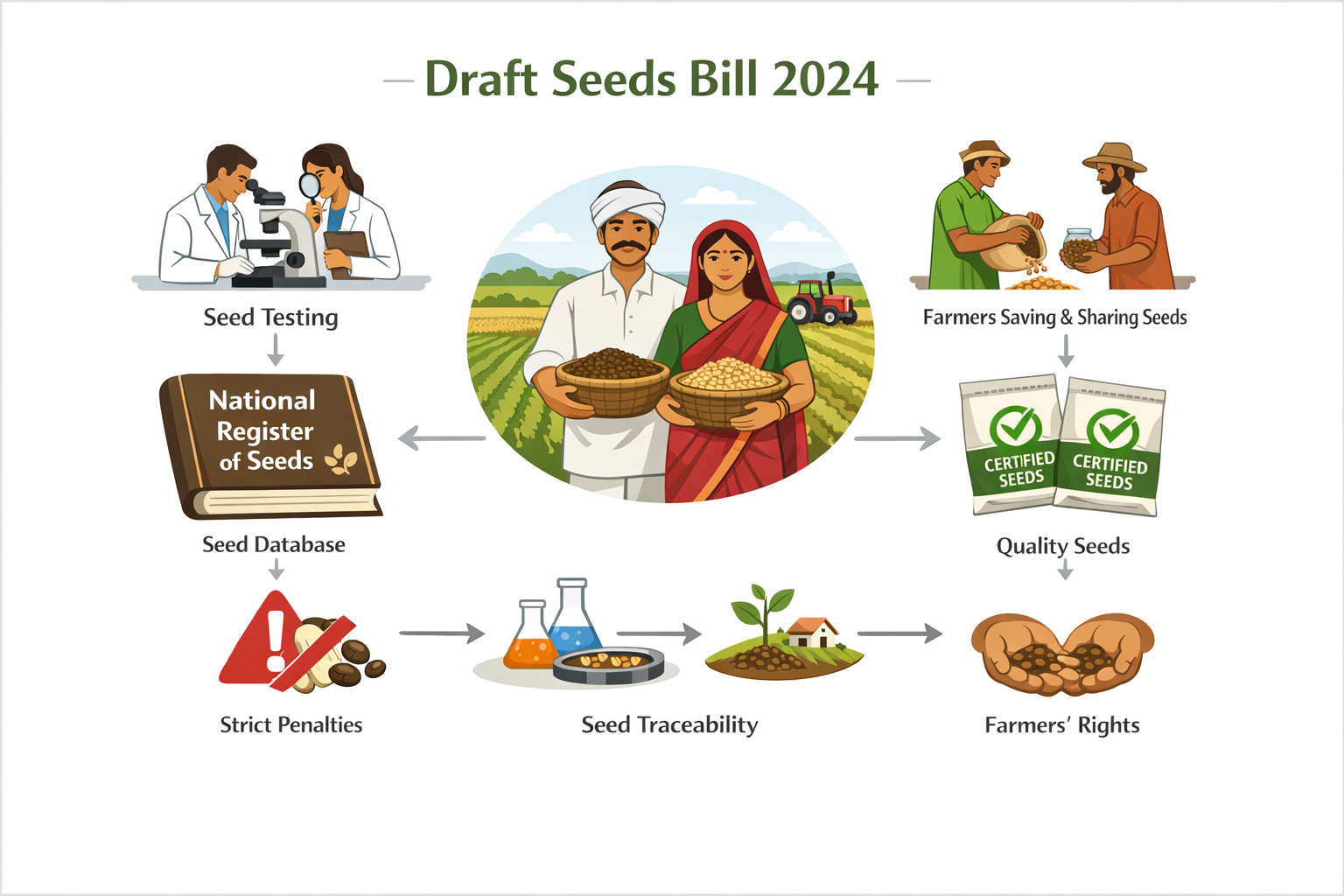
- Mandatory Registration: Unlike the 1966 Act, which required registration only for “Notified Varieties,” the Draft Bill mandates compulsory registration of all kinds and varieties of seeds aimed for sale.¹
- Seed Quality Assurance: It introduces stricter penalties for “misbranded” or sub-standard seeds to protect farmers from spurious inputs.
- Traceability: Implementation of a National Register of Seeds to maintain a database of all varieties sold in India.
- Farmers’ Exemption: The Bill contains a clause allowing farmers to save, use, share, and sell their farm-saved seeds, provided they do not sell them under a brand name.²
Comparative Framework of Seed regulation Acts/Bills
| Parameter | Seeds Act, 1966 (Current Law) | Protection of Plant Varieties and Farmers’ Rights (PPV&FR) Act, 2001 | Draft Seeds Bill, 2024 (Proposed) |
| Primary Goal | Quality Control (Germination/Purity). | Intellectual Property (IPR) & Farmers’ Rights. | Regulate Production, Sale & Import. |
| Registration | Mandatory only for Notified Varieties. | Voluntary (for IP protection). | Mandatory for all varieties sold. |
| Farmers’ Rights | Not explicitly defined. | Extensive rights to save, sow, resow, exchange, & sell non-branded seeds.³ | Retains exemption for non-branded seeds but focuses on market regulation. |
| Compensation | No provision for failure of performance. | Claim compensation if variety fails to perform. | Allows compensation claims via Consumer Courts (Consumer Protection Act). |
| Price Control | Controlled via Seeds (Control) Order, 1983. | Not applicable. | Repeals 1983 Order; Critics fear loss of price control mechanisms. |
Important Points to Note
The Draft Seeds Bill text explicitly states nothing shall restrict the farmer’s right to save, use, exchange, or sell farm seeds. The restriction applies only to selling under a brand name (e.g., selling loose seeds in a generic bag is allowed; selling in a packet marked “Super Yield X” is restricted).²
The Draft Bill does not replace the PPV&FR Act, 200 but it replaces the Seeds Act, 1966. The PPV&FR Act remains a separate, valid law focusing on IPR. However, critics argue the provisions of the Draft Bill (like mandatory registration) might practically contradict the spirit of the PPV&FR Act.
Sources
1. NCERT - Class XII Biology, Chapter 9: Strategies for Enhancement in Food Production (Seed Systems).
2. MoAFW - Draft Seeds Bill, 2019/2024 - [Official Text & Public Notice].
3. PPV&FR Authority - The Protection of Plant Varieties and Farmers’ Rights Act, 2001 (Section 39) - [Official Gazette].