The Ministry of Environment, Forest and Climate Change (MoEFCC) issued a clarification in January 2026 regarding the Forest (Conservation) Amendment Act, 2023. It is alleged that recent (January 2026) clarification on by (MoEFCC) allows non-government entities to participate in the ecological restoration of degraded forest lands (open and scrub forests) to achieve the national goal of 33% forest cover².
Restoration of Degraded Forest Landscapes
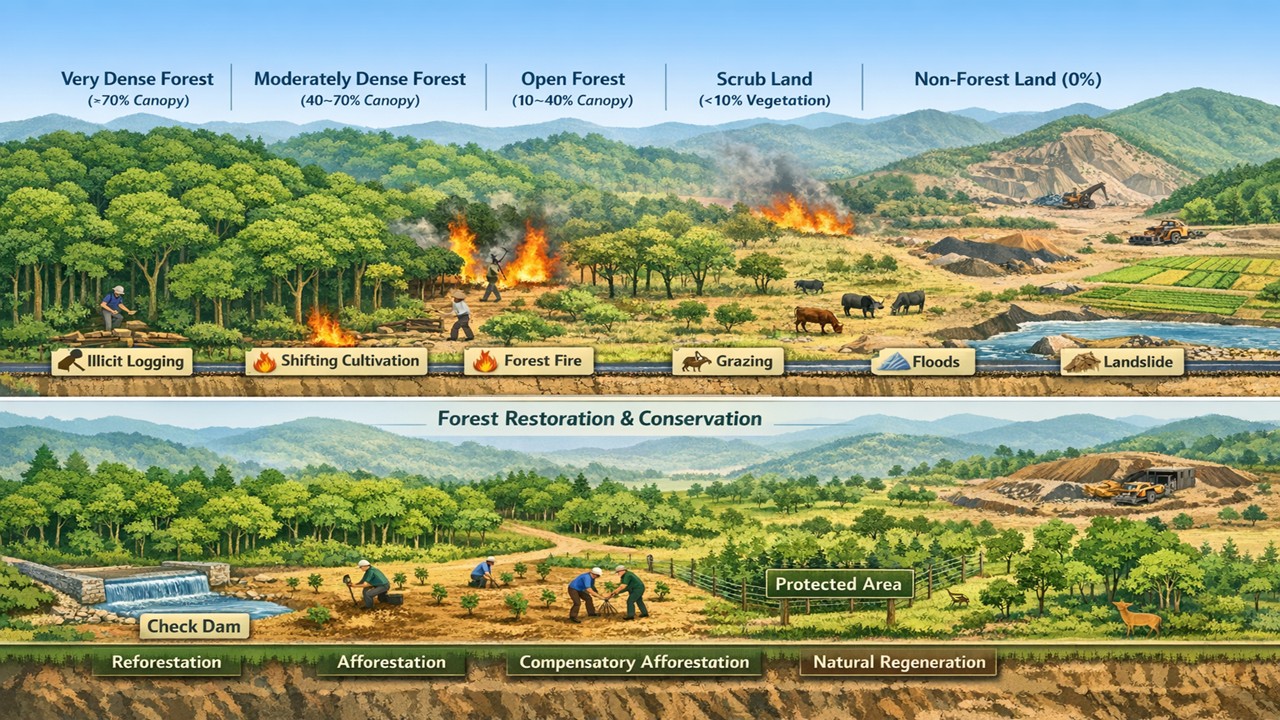
Lets focus on core concepts behind this news. As per India State of Forest Report 2023, a degraded forest is primarily characterized by a reduction in tree canopy density and the deterioration of the forest ecosystem due to various natural and anthropogenic factors.
Open Forests, Scrub and Non-forest lands have been categorised as Degraded Forest Landscapes
| State of Land | Canopy Density | Description / Transition |
| Very Dense Forest (VDF) | >70% | High-quality, intact forest cover. |
| Moderately Dense Forest (MDF) | 40% to <70% | Significant forest cover, but less dense than VDF. |
| Open Forest (OF) | 10% to <40% | The first major stage of degradation from VDF/MDF. |
| Scrub | <10% | Land with stunted trees or bushes; technically “degraded” beyond forest definition. |
| Non-Forest | 0% | The most severe form of degradation; total loss of forest cover. |
Causes of Degradation (Indian State of Forest Report 2023)
Forest degradation is driven by specific disturbances and land-use changes:
- Shifting Cultivation: In the North Eastern States, Jhum (shifting cultivation) involves slashing and burning forests for agriculture, which is a major cause of forest degradation and fire.
- Anthropogenic Pressures: Human activities such as illicit felling, lopping (cutting branches for fodder/fuel), and encroachment contribute significantly to degradation.
- Biotic Influence: This includes over-grazing by animals and uncontrolled forest fires, which inhibit regeneration and alter the forest structure
- Natural Calamities: Events such as landslides, storms, and floods can also degrade forest cover
Restoration Potential Degraded forests, particularly Open Forests and Scrub, are viewed as having high potential for restoration through forestry interventions. India has pledged to restore 26 million hectares of degraded land by 2030 under the Bonn Challenge
“Non-Forest Purpose” As per Forest Conservation Act 1980
“Non-forest purpose” is defined as the breaking up or clearing of any forest land or portion thereof for:
- Commercial Cultivation: The cultivation of tea, coffee, spices, rubber, palms, oil-bearing plants, horticultural crops, or medicinal plants.
- General Non-Reforestation: Any purpose other than reafforestation
- Specific Activities Classified as Non-Forest Purpose –
• Mining: Extraction of minerals (including underground mining and removal of boulders/sand from riverbeds) is considered a non-forestry activity.
• Cultivation: Cultivation of fruit-bearing trees, oil-bearing plants (including Jatropha), or medicinal plants requires approval unless the species are indigenous or part of an afforestation program.
• Infrastructure: Projects such as schools, hospitals, and residential buildings are generally considered non-forest uses
Activities Excluded from “Non-Forest Purpose” (Exceptions)
Forest (Conservation) Amendment Act, 2023, list activities that are not treated as non-forest purposes. These are viewed as ancillary to conservation and forest management:
- Silvicultural operations and regeneration.
- Establishment of check-posts and infrastructure for frontline forest staff.
- Fire lines and wireless communications.
- Construction of fencing, boundary marks, bridges, culverts, check dams, waterholes, trenches, and pipelines
- Establishment of zoos and safaris owned by the Government or any authority, located in forest areas other than protected areas
- Eco-tourism facilities included in the Forest Working Plan, Wildlife Management Plan, or Tiger Conservation Plan
- Surveys: Surveys such as reconnaissance, prospecting, investigation, or exploration (including seismic surveys) are not treated as non-forest purposes, subject to terms specified by the Central Government
Reforestation vs Afforestation vs Compensatory afforestation
Reforestation → Re-grow forests. Re-planting trees in an area where forests previously existed but were cut down or degraded.
Afforestation → Add forests. Planting trees on land that was not previously forested.
| Feature | Reafforestation | Compensatory Afforestation (CA) |
|---|---|---|
| Primary Purpose | Forest management; regenerating forest cover on existing forest land. | Mitigating the loss of forest land caused by development/diversion. |
| Land Type | Occurs on existing forest land. | Occurs on non-forest land or degraded forest land. |
| Legal Classification | Considered a “forest purpose” (not “non-forest purpose”). | A mandatory condition for granting “non-forest use” approval. |
| Restriction | Cannot clear naturally grown trees to undertake reafforestation without approval,. | Must result in the land being legally notified as Reserved or Protected Forest |
Sources
1. The Gazette of India - Forest (Conservation) Amendment Act, 2023 (No. 15 of 2023) - [Official PDF via MoEFCC]
2. Indian state of Forest Report 2023 Volume I and II
3. NCERT Class 12 Geography/Biology - Principles of Forest Conservation (Contextual reference for silviculture)