Recent military exercises by Iran’s Islamic Revolutionary Guard Corps (IRGC) in the Strait of Hormuz have reignited concerns over the stability of the world’s most vital energy chokepoint, where disruptions threaten nearly 20% of global petroleum consumption and India’s energy stability.
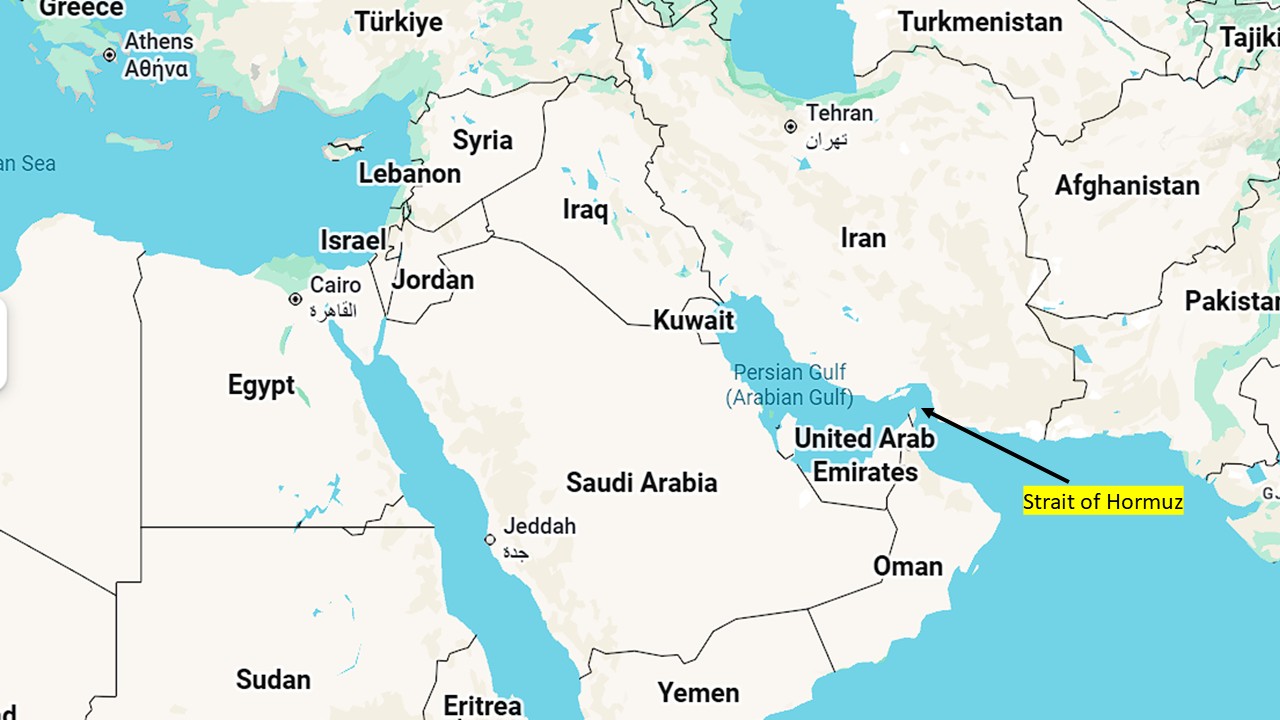
The Strait of Hormuz is a narrow maritime passage that acts as the sole sea exit from the Persian Gulf to the Gulf of Oman. Its strategic value is derived from its “chokepoint” nature a narrow channel along a widely used sea route where even temporary closures can trigger massive spikes in global energy prices.
- Geographic Dimensions: It separates Iran to the north from Oman (Musandam Peninsula) and the UAE to the south. At its narrowest point, the width is approximately 21 nautical miles (39 km).
- To manage heavy tanker traffic, international shipping lanes consist of two 2-mile-wide (3 km) navigable channels (one inbound, one outbound) separated by a 2-mile-wide buffer zone¹.
- In 2024, oil flows averaged 20 million barrels per day (b/d), accounting for about 20% of global petroleum liquids consumption and 20% of global Liquefied Natural Gas (LNG) trade (primarily from Qatar)¹.
Core Concepts for UPSC Prelims
1. Strategic Geography & Sovereignty
The shipping lanes in the Strait pass through the territorial waters of Iran and Oman. However, navigation is governed by the United Nations Convention on the Law of the Sea (UNCLOS), which provides for “Transit Passage” allowing vessels to pass through straits used for international navigation solely for the purpose of continuous and expeditious transit¹.
2. Alternative Routes & Limitations
While some countries have invested in bypass infrastructure, they cannot replace the Strait’s total volume:
- Saudi Arabia’s East-West Pipeline: Transports crude from eastern fields to the Red Sea port of Yanbu. It has a design capacity of roughly 5–7 million b/d, but significant spare capacity is required to bypass Hormuz fully¹.
- UAE’s Habshan-Fujairah Pipeline (ADCOP): Connects Abu Dhabi’s onshore fields to the port of Fujairah on the Gulf of Oman, bypassing the Strait with a capacity of 1.5 million b/d².
- Iraq: Primarily uses the Basra terminals; its alternative routes (like the Ceyhan pipeline via Turkey) have faced geopolitical and technical hurdles.
3. Impact on India’s Energy Security
India is a net importer of crude oil, and its dependence on the Persian Gulf remains significant despite diversification:
- In 2024-25, over 50% of India’s crude oil imports originated from the Gulf (Iraq, Saudi Arabia, UAE)³.
- Approximately 70% of India’s LNG supplies transit through the Strait of Hormuz, making India one of the most vulnerable nations to maritime disruptions in this corridor².
- Domestic fuel prices in India are highly sensitive to global crude volatility. A disruption at Hormuz leads to increased shipping insurance premiums and freight rates, causing imported inflation.
Under UNCLOS, the right of transit passage applies to straits used for international navigation. A total blockade would likely be viewed as a violation of international law and a “casus belli” (act of war) by major powers¹.
UPSC Prelims Style MCQs
Q1. With reference to the Strait of Hormuz, consider the following statements:
- It connects the Persian Gulf with the Gulf of Aden.
- The shipping lanes pass through the territorial waters of Iran and Oman.
- Approximately 50% of global seaborne oil trade transits through this strait.
Which of the statements given above is/are correct?
A) 1 and 2 only
B) 2 only
C) 2 and 3 only
D) 1, 2, and 3
Q2. Which of the following pipelines provides a partial alternative to the Strait of Hormuz for oil exports?
A) Tapline
B) Habshan-Fujairah (ADCOP) Pipeline
C) Nord Stream 2
D) BTC Pipeline
Q3. Regarding India’s energy security and the Strait of Hormuz, which statement is most accurate?
A) India imports 100% of its crude oil through the Strait of Hormuz.
B) More than 70% of India’s LNG imports transit through this corridor.
C) Russia is the largest exporter of oil through the Strait of Hormuz to India.
D) India has no strategic petroleum reserves to mitigate Hormuz-related disruptions.
Answers
Q1. Correct Answer: B (2 only)
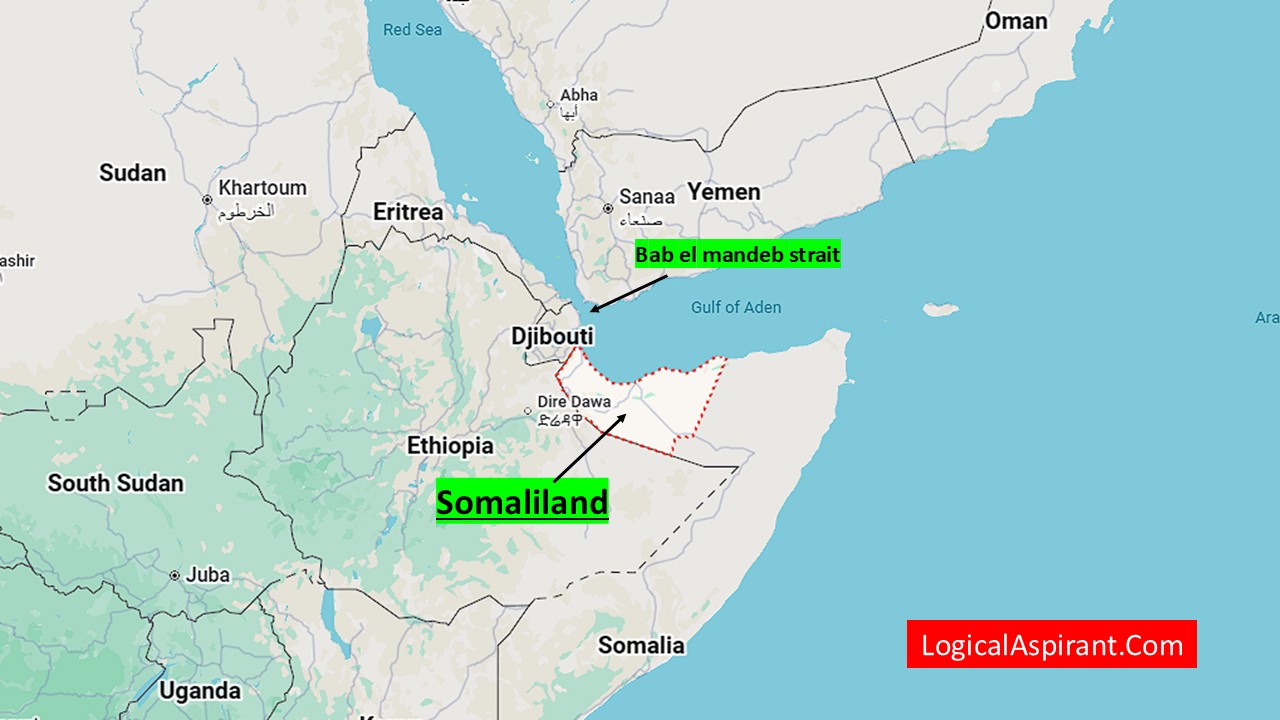
- Statement 1 is wrong: It connects the Persian Gulf with the Gulf of Oman. The Gulf of Aden is thousands of miles away, separated by the Arabian Sea and the Bab el-Mandeb strait.
- Statement 3 is wrong: It carries nearly 20% to 30% of global seaborne oil. While massive, “50%” is an exaggeration of its current global share.
Q2. Correct Answer: B (Habshan-Fujairah Pipeline)
- Option A is wrong (Tapline): The Trans-Arabian Pipeline is an old, largely inactive project that historically moved oil to the Mediterranean, not used as a modern Hormuz bypass.
- Option C is wrong (Nord Stream 2): This is a natural gas pipeline connecting Russia to Germany via the Baltic Sea; it has no geographic connection to the Middle East.
- Option D is wrong (BTC Pipeline): The Baku-Tbilisi-Ceyhan pipeline carries oil from the Caspian Sea (Azerbaijan) to the Mediterranean; it does not bypass the Persian Gulf.
Q3. India’s Energy Security Correct Answer: B (More than 70% of India’s LNG imports transit through this corridor.)
Sources