India’s urban policy is entering a new phase. The Union Cabinet has approved the Urban Challenge Fund (UCF) with ₹1 lakh crore in Central assistance under the Ministry of Housing and Urban Affairs (MoHUA)¹. But this is not just another urban scheme. It represents a fundamental redesign of how Indian cities finance development.
From Grants to Market Discipline
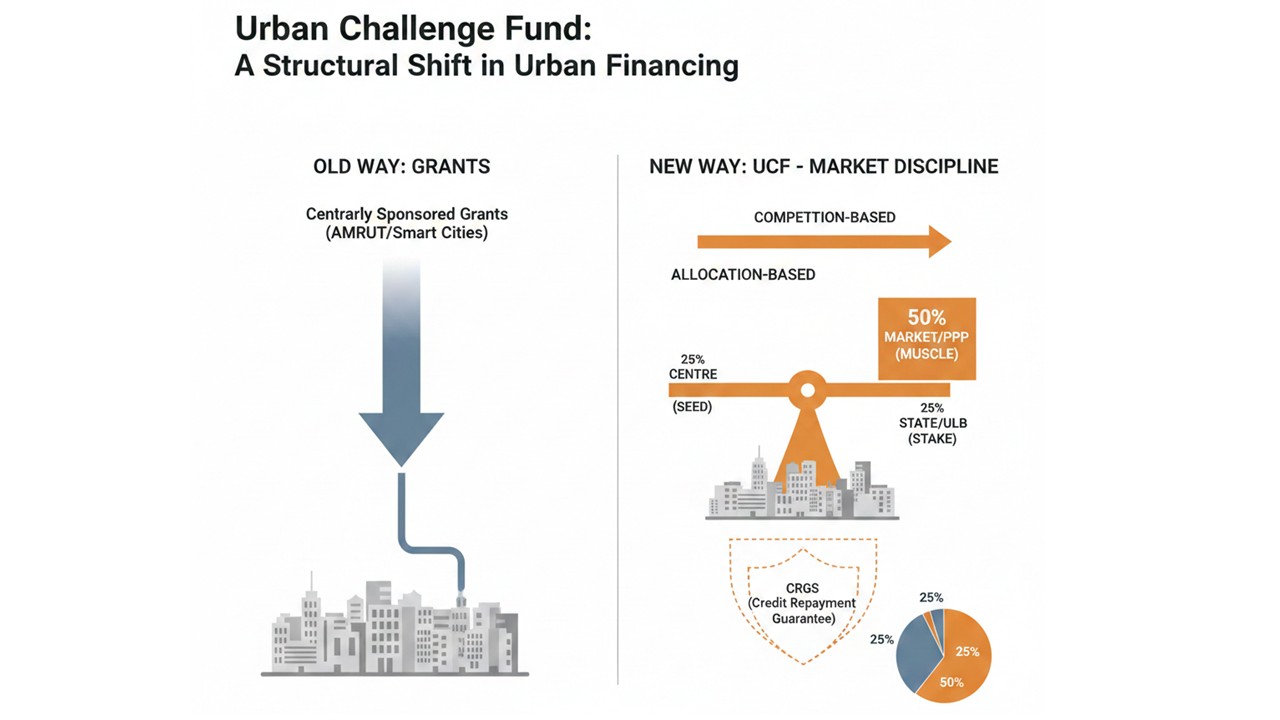
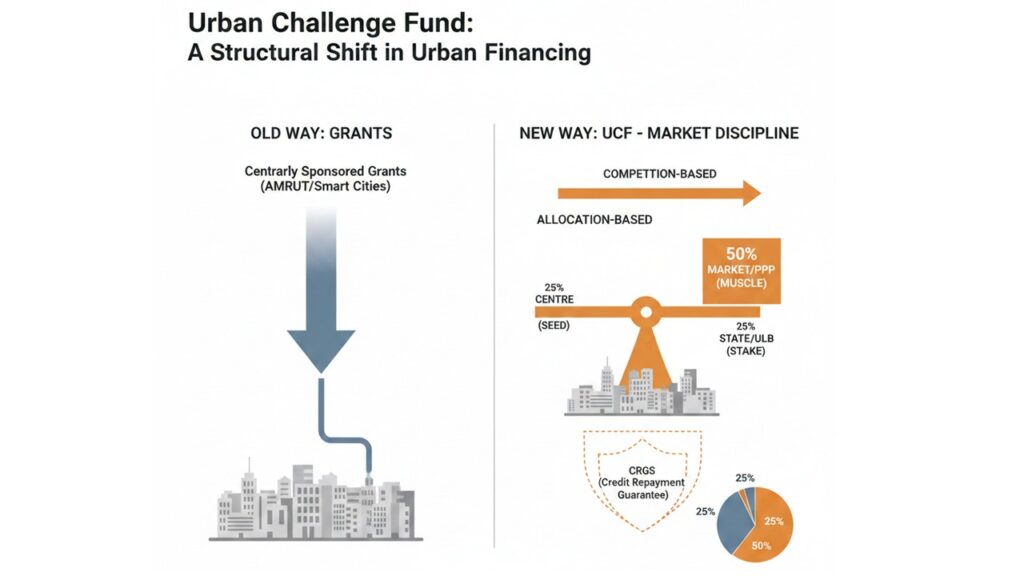
For decades, urban infrastructure relied heavily on centrally sponsored grants – Smart Cities Mission, AMRUT, JNNURM. UCF marks a shift:
- Central government funds only 25% of project cost¹.
- Cities must raise at least 50% from market sources – municipal bonds, bank loans, PPPs¹.
- The remaining 25% comes from State/ULBs¹.
Instead of “allocation-based funding,” cities now compete under a challenge mode – projects must be feasible, reform-linked, and bankable.
The goal is to Mobilise ₹4 lakh crore in total urban investment over five years¹.
Why This Matters for Governance
Urban Local Bodies derive constitutional status from Part IXA (Articles 243P–243ZG)². However, financial autonomy remains weak.
Market borrowing pushes cities to:
- Improve accounting standards
- Strengthen revenue systems (property tax, user charges)
- Enhance creditworthiness
Protecting Smaller Cities: Credit Repayment Guarantee Scheme (CRGS)
Recognising that smaller cities lack market access, the government created a ₹5,000 crore guarantee corpus¹. Under the Credit Repayment Guarantee Scheme (CRGS):
- For the first loan, the Central government will guarantee up to 70% of the loan amount or ₹7 crore, whichever is lower.
- For later loans, the guarantee reduces to 50% of the loan amount or ₹7 crore, whichever is lower.
- The scheme supports 4,223 cities, including many Tier-2 and Tier-3 cities, to help them access bank loans more easily.
The Central government acts as a safety support for banks. If a smaller Urban Local Body fails to repay part of its loan, the Centre covers the guaranteed portion. This reduces the bank’s risk and makes it easier for smaller cities to get loans
Why This Is Structurally Important
The scheme was announced in the Budget 2025–26 as a ₹1 lakh crore Urban Challenge Fund to support key urban development themes — strengthening cities as growth hubs, promoting creative redevelopment of urban areas, and upgrading water and sanitation infrastructure. It will operate from FY 2025–26 to FY 2030–31, with a provision for extension up to FY 2033–34.
India’s urbanisation is accelerating (Census 2011: 31% urban)³. Infrastructure financing needs are massive. UCF signals a transition from welfare-style urban funding to credit-based, accountability-driven urban governance.
Sources
1. PIB – Ministry of Housing & Urban Affairs (Cabinet approval release)
2. Constitution of India – Part IXA
3. Census of India 2011 (Registrar General of India)