While malaria is often viewed as a rural disease associated with forests and stagnant natural water bodies, recent trends highlight a shift towards Urban Malaria. The core concept here isn’t just the disease itself, but the biological adaptation of its vector (the mosquito) to human-made environments.
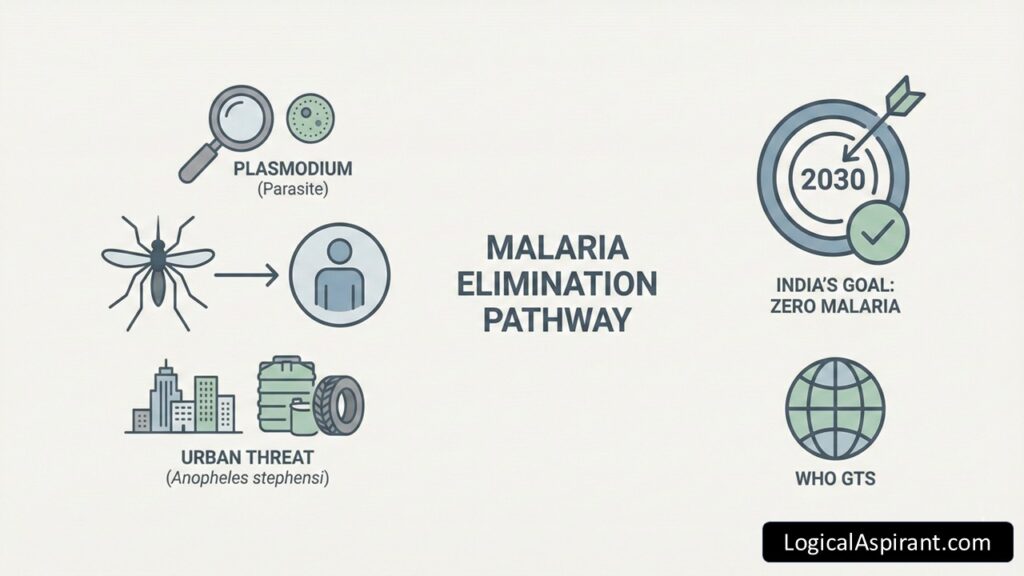
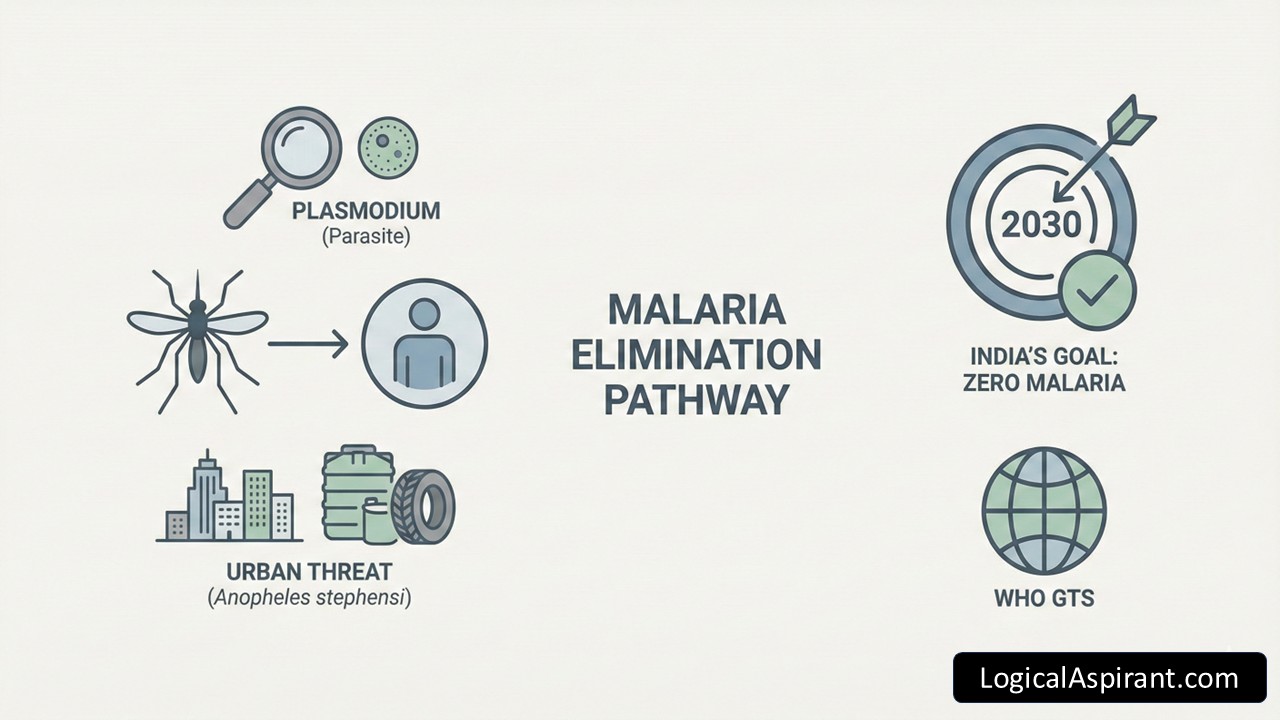
The Pathogen (The Cause) Malaria is caused by a protozoan parasite of the genus Plasmodium. It is not caused by a virus or bacteria.
- There are five parasite species that infect humans: P. falciparum (most deadly), P. vivax (most common outside Africa), P. malariae, P. ovale, and P. knowlesi (zoonotic, originally found in macaques).
- Being a protozoan means it is a single-celled eukaryote, which makes it biologically more complex than bacteria.
The Vector (The Carrier) The parasite is transmitted solely by the female Anopheles mosquito.
- Why only females? Male mosquitoes feed exclusively on flower nectar. Only the female bites humans because she requires the protein found in blood to develop her eggs.
- Unlike Aedes (dengue) mosquitoes which are day-biters, Anopheles are primarily crepuscular (active at dusk/dawn) or nocturnal.
When an infected mosquito bites, it injects the parasite (in sporozoite form) into the human bloodstream.The parasites travel to the liver to mature —-> Re-enter the bloodstream and infect Red Blood Cells (RBCs) —-> bursting of RBCs releases toxins, causing the characteristic cycles of fever and chills.
Anopheles Stephensi and Urbanisation
The recent news focuses on Anopheles stephensi, a specific mosquito species that complicates malaria elimination.
Most Anopheles species prefer rural settings with clean, natural water bodies (streams, ponds). However, Anopheles stephensi has evolved to become an efficient urban vector.
- It thrives in man-made containers common in cities, such as overhead water tanks, cooler tanks, discarded tyres, and construction sites.
- It is considered an invasive species in many new regions (expanding from Asia to Africa) because it adapts quickly to city life.
- It efficiently transmits both major parasites – P. falciparum and P. vivax.
Policy Context: Elimination vs. Eradication India aligns its goals with the WHO Global Technical Strategy (GTS) 2016–2030.
- 2027 Target: Zero indigenous cases (local transmission stopped).
- 2030 Target: Complete malaria elimination (certification of malaria-free status).
You must understand this difference –
- Viral vs. Protozoan.
- Confusion: Aspirants often group Malaria with Dengue and Chikungunya.
- Correction: Dengue and Chikungunya are Viral. Malaria is Protozoan. Antibiotics/Antivirals do not work on malaria; anti-parasitics (like Artemisinin) are used.
- Male vs. Female Mosquitoes.
- Confusion: “Mosquitoes bite humans.”
- Correction: Only female mosquitoes bite. If a statement says “Male Anopheles transmit malaria,” it is false.
- Clean vs. Dirty Water.
- Confusion: Thinking all mosquitoes breed in dirty drains.
- Correction: Anopheles (Malaria) and Aedes (Dengue) prefer clean/stagnant water. Culex (Filaria/Japanese Encephalitis) prefers polluted/dirty water.