The Government of India has approved the Holistic Development of Great Nicobar Island (HDGNI) project, a ₹72,000-crore mega infrastructure initiative led by NITI Aayog to develop a transshipment port, airport, township and defense facilities on Great Nicobar Island.
The project has triggered concerns related to environmental clearance, tribal rights, biodiversity loss, and strategic geopolitics.
Strategic Geography of Great Nicobar Island
Great Nicobar is India’s southernmost island, located near the western entrance of the Strait of Malacca, a critical global maritime chokepoint¹.
Nearly 40% of global trade and most of China’s energy imports transit through this strait¹.
From a defence perspective, infrastructure here strengthens India’s Indian Ocean Region (IOR) surveillance and logistics capacity (relevant to maritime security doctrine)².
Container Transshipment Terminal (CTT)
Transshipment refers to transfer of cargo containers from large mother vessels to feeder vessels at an intermediate port³. India currently handles ~75% of its transshipment cargo at foreign ports like Colombo and Singapore³.
The proposed International Container Transshipment Terminal at Galathea Bay aims to handle 14.2 million TEUs annually (1 TEU = 20-foot container)¹.
Environmental Concerns
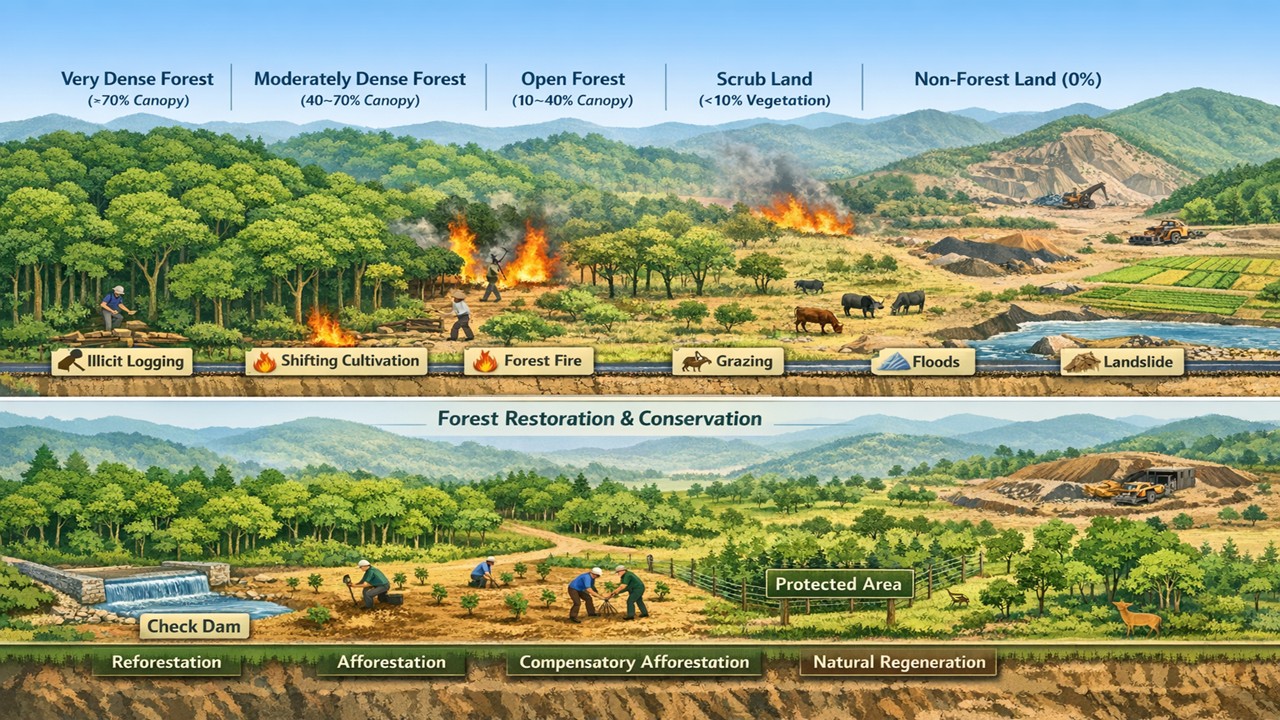
The project aims to divert 130.75 sq km of forest land, involving felling of ~9.64 lakh trees (government estimate)¹. The island hosts endemic fauna such as the Nicobar megapode and Nicobar tree shrew, whose habitats are restricted to these forests⁷. For that purpose compensatory afforestation is proposed in Haryana, despite ecological non-comparability with tropical evergreen forests⁵.
Moreover Environmental Impact Assessment (EIA) Process require scientific assessment of environmental consequences before project approval⁴. MoEFCC guidelines mandate multi-season ecological data collection for large infrastructure projects⁴. Critics argue that for HDGNI EIA relied on single-season data, raising questions of due diligence¹.
Parts of Great Nicobar fall under a UNESCO-designated Biosphere Reserve, intended to balance conservation with sustainable use¹¹. Denotification for infrastructure weakens the Man and Biosphere (MAB) Programme principles¹¹.
Galathea Bay
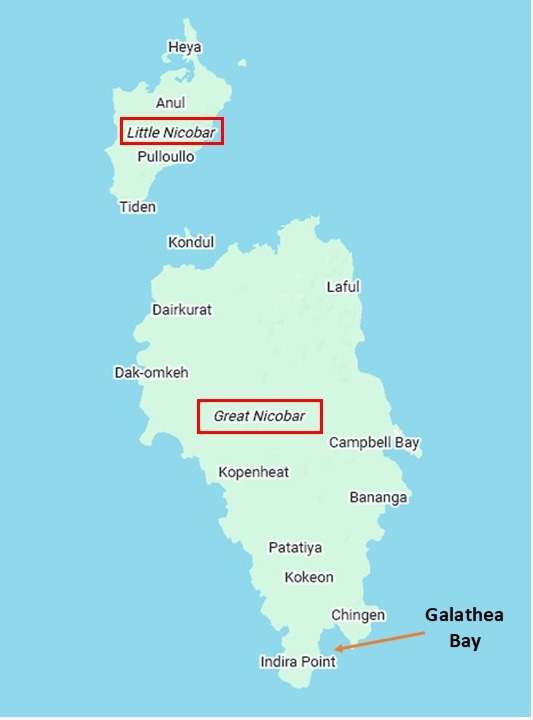
International Container Transshipment Terminal is proposed at Galathea Bay.
Galathea Bay is a key nesting site for the giant leatherback turtle (Dermochelys coriacea), listed as Vulnerable on the IUCN Red List⁶.
Over 20,000 coral colonies may be affected; coral translocation has globally documented low survival rates⁸.
Tribal Rights & Forest Rights Act (FRA), 2006
Great Nicobar is home to the Nicobarese and Shompen tribes. The Shompen are classified as a Particularly Vulnerable Tribal Group (PVTG) under Ministry of Tribal Affairs norms⁹.
Section 4(5) and Section 6 of the Forest Rights Act, 2006 require free, prior and informed consent of Gram Sabhas before forest diversion¹⁰. Critics allege procedural lapses in obtaining consent¹.
Key Details of project
| Parameters | Official Details |
|---|---|
| Total Project Area | ~166 sq km (≈18% of island area)¹ |
| Forest Land Diverted | 130.75 sq km⁵ |
| Estimated Trees Felled | ~9.64 lakh¹ |
| Planned Port Capacity | 14.2 million TEUs/year¹ |
| Affected Coral Colonies | >20,000¹ |
| Power Plant | 450-MVA gas + solar based¹ |
| Population Projection | ~8,000 → 3.5 lakh in 30 years¹ |
Sources
1. The Hindu – Holistic Development of Great Nicobar Island Project – Official reportage
2. Ministry of Defence – Indian Ocean Region maritime doctrine documents
3. Ministry of Ports, Shipping and Waterways – Transshipment policy notes
4. MoEFCC – EIA Notification, 2006
5. Ministry of Environment, Forest and Climate Change – Forest (Conservation) Act, 1980
6. IUCN Red List – Dermochelys coriacea assessment
7. Zoological Survey of India – Fauna of Andaman & Nicobar Islands
8. UNEP – Coral reef restoration and translocation reports
9. Ministry of Tribal Affairs – PVTG classification guidelines
10. Government of India – Forest Rights Act, 2006
11. UNESCO – Man and Biosphere Programme documents