Amidst global shifts toward low-carbon circular economies, India is scaling its biomaterials sector, highlighted by major industrial investments like Balrampur Chini Mills’ PLA plant in Uttar Pradesh and the emergence of startups converting floral waste into bio-based products.¹
Biomaterials and Biomanufacturing
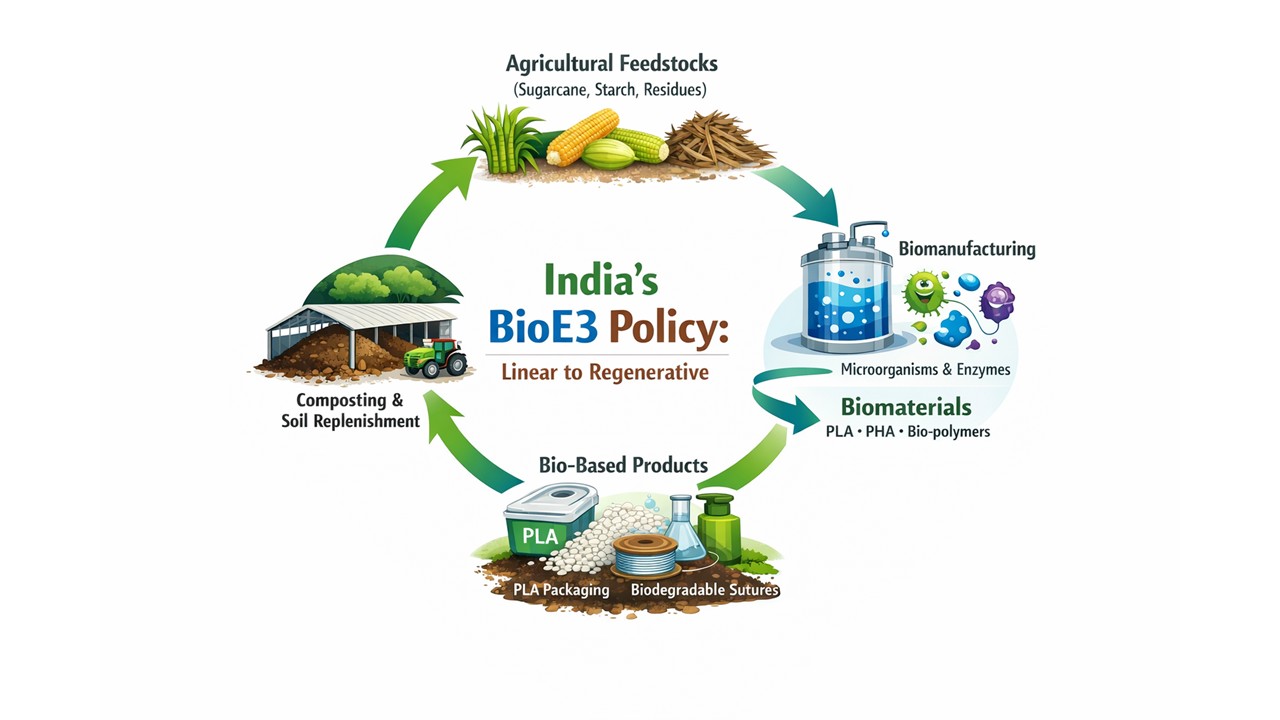
Biomaterials are materials derived from biological sources (plant sugars, starch, residues) or engineered via biological processes to interact with or replace conventional synthetic materials.¹
These materials are produced by Biomanufacturing, which utilizes biological systems (living cells, enzymes, microorganisms) as “mini-factories” to produce molecules and materials.¹
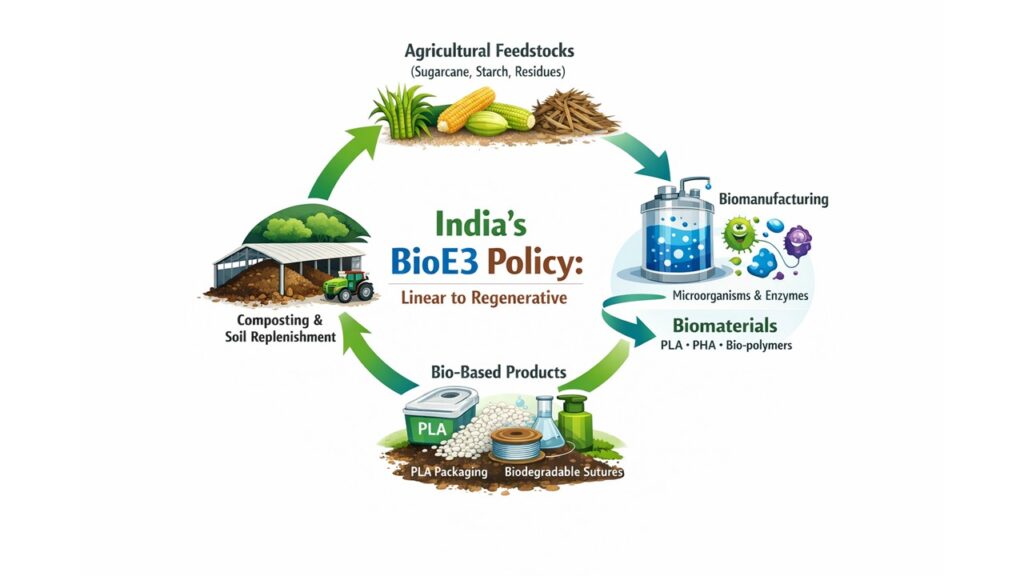
Unlike petroleum-based plastics that follow a linear “take-make-waste” model, biomaterials aim for a closed-loop system where agricultural feedstocks are converted into products that are ideally compostable or recyclable.
Biomaterials are classified based on their chemical relationship to conventional materials and their end-of-life behavior.
| Parameter | Drop-in Biomaterials | Drop-out (Non-drop-in) | Novel Biomaterials |
| Chemistry | Identical to petroleum-based versions (e.g., Bio-PET).¹ | Chemically unique (e.g., Polylactic Acid – PLA).¹ | Entirely new properties (e.g., self-healing).¹ |
| Infrastructure | Compatible with existing manufacturing systems.¹ | Requires new processing/end-of-life systems.¹ | Requires specialized advanced tech.¹ |
| Example | Bio-polyethylene (Bio-PE). | Biodegradable sutures, PLA packaging. | Bioactive tissue scaffolds. |
The expansion of the biomaterials sector is a critical pillar of India’s Viksit Bharat @2047 vision, and BioE3 policy transitioning the nation from an extractive chemical-based economy to a regenerative bio-based one.¹
Myth vs. Reality: Understanding Biomaterials
Misconception: All biomaterials/bioplastics are biodegradable and can be composted in a home garden.
Reality: Many biomaterials, like PLA, require Industrial Composting conditions (high temperature and specific microbial activity) to break down; they will not degrade quickly in a standard landfill or ocean.¹
Misconception: “Bio-based” and “Biodegradable” mean the same thing.
Reality: Bio-based refers to the origin (plant-derived), while Biodegradable refers to the end-of-life (ability to break down). A material can be bio-based but non-biodegradable (e.g., Bio-PET).¹
UPSC Prelims Relevant MCQ
Q. Which of the following is/are potential risks associated with the large-scale scaling of biomaterials in India?
1. Competition between feedstock and food security.
2. Increased water stress due to intensive cultivation of feedstock crops.
3. Soil deterioration from aggressive agricultural practices.
Select the correct answer using the code given below:
(a) 1 and 2 only
(b) 2 and 3 only
(c) 1 and 3 only
(d) 1, 2, and 3
Correct Answer: (d) 1, 2, and 3 Explanation: Scaling feedstocks like maize and sugarcane for bioplastics can lead to food-vs-fuel/material conflicts and environmental strain on land and water resources.¹
Sources
1. The Hindu - What are biomaterials and why does India need them? (Analysis by Shambhavi Naik, Takshashila Institution).
2. Ministry of Science & Technology (DBT) - BioE3 Policy (Biotechnology for Economy, Environment and Employment).