The High Seas Treaty, formally the BBNJ Agreement, officially enters into force on 17 January 2026, 120 days after achieving the mandatory 60 ratifications¹. This historic agreement under the UNCLOS framework establishes the first centralized legal mechanism to conserve marine biodiversity in the High Seas, which cover nearly 50% of the Earth’s surface.
Biodiversity Beyond National Jurisdiction (BBNJ)
The BBNJ Agreement is the third implementing agreement under the UN Convention on the Law of the Sea (UNCLOS), 1982. It specifically addresses the “governance gap” in areas outside any single nation’s control.
The “Package Deal” (4 Pillars of BBNJ):
- Marine Genetic Resources (MGRs): Establishes rules for sharing benefits (monetary and non-monetary) derived from deep-sea life (e.g., sponges used for cancer drugs). It applies the principle of equitable sharing to these resources².
- Area-Based Management Tools (ABMTs): Creates a mechanism to establish Marine Protected Areas (MPAs) in the high seas to conserve vulnerable ecosystems.
- Environmental Impact Assessments (EIAs): Mandates strict assessments for activities in the high seas (e.g., geo-engineering) that could harm marine biodiversity³.
- Capacity Building: Requires transfer of marine technology to developing states to ensure they can participate in high seas research.
“High Seas” Definition under UNCLOS
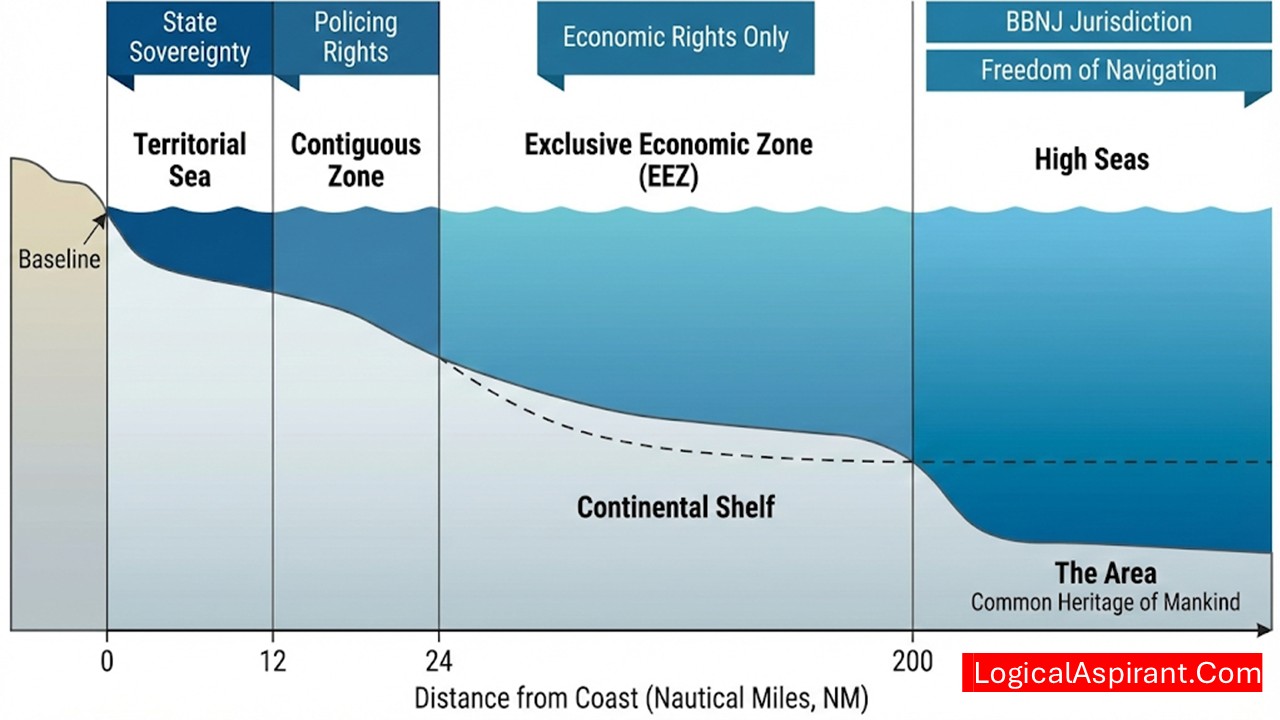
Under UNCLOS, the ocean is divided into zones. The High Seas are all parts of the sea not included in:
- Exclusive Economic Zone (EEZ)
- Territorial Sea
- Internal Waters
- Archipelagic Waters
BBNJ Treaty applies to Areas Beyond National Jurisdiction (ABNJ), which comprises two distinct zones:
- The High Seas: The water column beyond the EEZ.
- The Area: The seabed and ocean floor beyond the limits of the national continental shelf.
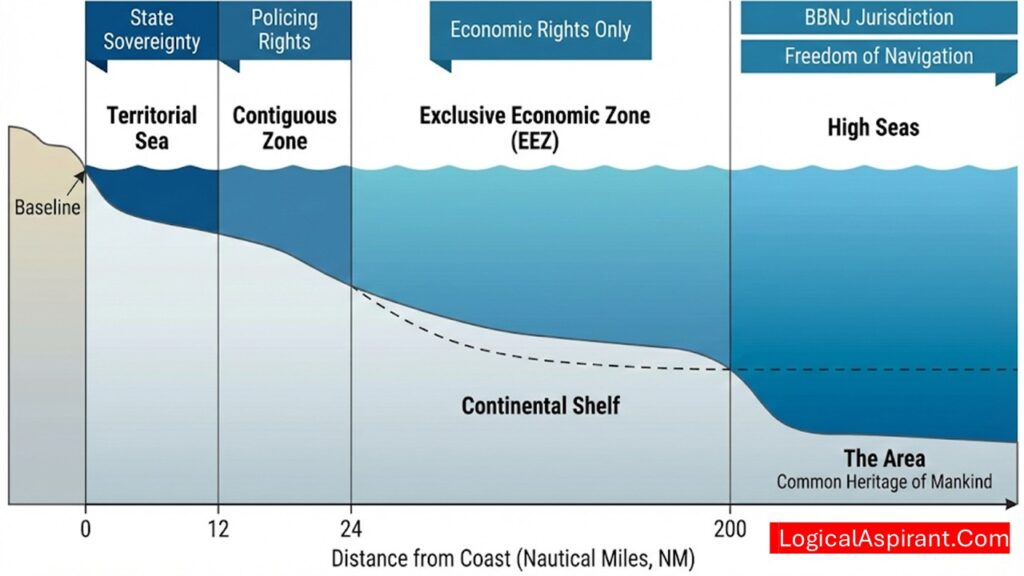
Maritime Zones Comparison (UNCLOS)
| Zone | Distance (from Baseline) | Sovereignty / Rights | Relevant Authority |
| Territorial Sea | 0 – 12 nautical miles (NM) | Full Sovereignty (air, water, seabed). | Coastal State |
| Contiguous Zone | 12 – 24 NM | Limited enforcement (customs, fiscal, immigration, sanitary). | Coastal State |
| Exclusive Economic Zone (EEZ) | 12 – 200 NM | Sovereign rights for exploring/exploiting resources (fishing, energy). No sovereignty over water surface. | Coastal State |
| High Seas (Water column) | Beyond 200 NM (usually) | Freedom of High Seas (navigation, overflight, fishing). No sovereignty. | BBNJ (New) / IMO / RFMOs |
| The Area (Seabed) | Beyond Continental Shelf | Common Heritage of Mankind. | ISA (Intl. Seabed Author |
Important points to note
The BBNJ is an Implementing Agreement under UNCLOS. It interprets and applies UNCLOS provisions specifically for biodiversity. It does not undermine existing frameworks like the International Maritime Organization (IMO) or International Seabed Authority (ISA)¹.
Misconception: “High Seas” and “International Waters” mean the same thing legally.?
Reality: “International Waters” is a informal term. UNCLOS strictly defines High Seas (water column) and The Area (seabed). Seabed is the “Common Heritage of Mankind” (managed by International Seabed Authority), while the High Seas historically operated under “Freedoms” (now regulated by BBNJ)⁴.
The BBNJ does not ban fishing. It allows for the creation of Marine Protected Areas (MPAs) where fishing might be restricted to protect biodiversity, but general fishing rights remain protected under UNCLOS freedoms⁵.
Sources
1. United Nations (DOALOS) - Agreement under the United Nations Convention on the Law of the Sea on the Conservation and Sustainable Use of Marine Biological Diversity of Areas beyond National Jurisdiction - [official text]
2. European Commission - High Seas Treaty: A Historic Deal for the Ocean
3. NCERT - Class 11 Fundamentals of Physical Geography (Chapter: Water (Oceans))
4. UNCLOS 1982 - Part VII: High Seas (Article 86)
5. IUCN - BBNJ Agreement: Explainer