The Supreme Court recently critiqued the Secretary General of the Rajya Sabha for exceeding his administrative mandate by drafting a decision to reject a removal motion against Justice Yashwant Varma. The Court clarified that the decision to admit or refuse a motion for the removal of a judge rests solely with the Speaker of the Lok Sabha or the Chairman of the Rajya Sabha, and the Secretariat must restrict itself to administrative functions rather than assuming quasi-adjudicatory roles.
Removal of Judges
The Constitution of India safeguards the independence of the judiciary by making the removal process of Supreme Court and High Court judges rigorous and difficult. A judge can be removed from office only by an order of the President, passed after an address by each House of Parliament supported by a specific majority.¹
The Constitution specifies only two grounds for removal under article 124 (4) –
- Proved misbehaviour
- Incapacity¹
Aricle 124 (4) – A Judge of the Supreme Court shall not be removed from his office except by an order of the President passed after an address by each House of Parliament supported by a majority of the total membership of that House and by a majority of not less than two-third of the members of the House present and voting has been presented to the President in the same session for such removal on the ground of proved misbehavior or incapacity.
Article 124(5) explains how this process should be carried out
Article 124(5) – Parliament may by law regulate the procedure for the presentation of an address and for the investigation and proof of the misbehavior or incapacity of a Judge under clause.
Accordingly, the Judges (Inquiry) Act, 1968 was enacted to regulate the procedure for the investigation and proof of misbehaviour or incapacity of a Judge of the Supreme Court or of a High Court.²
The Process under The Judges (Inquiry) Act, 1968
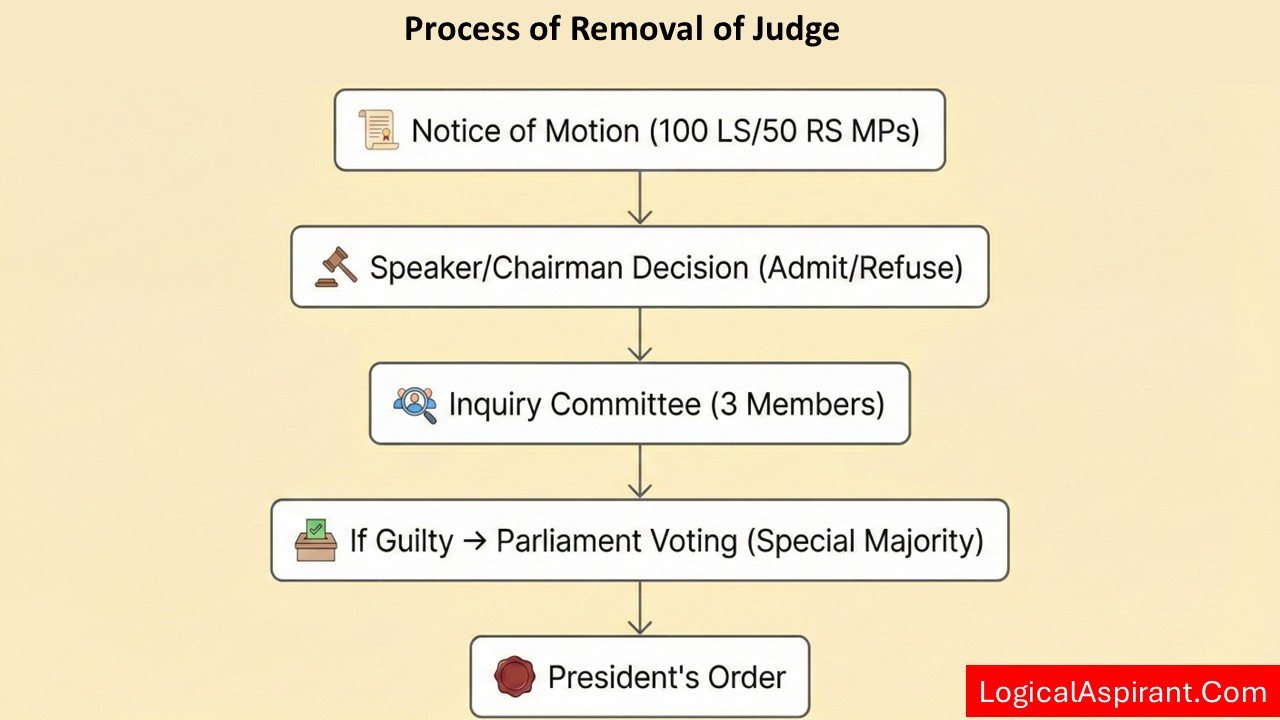
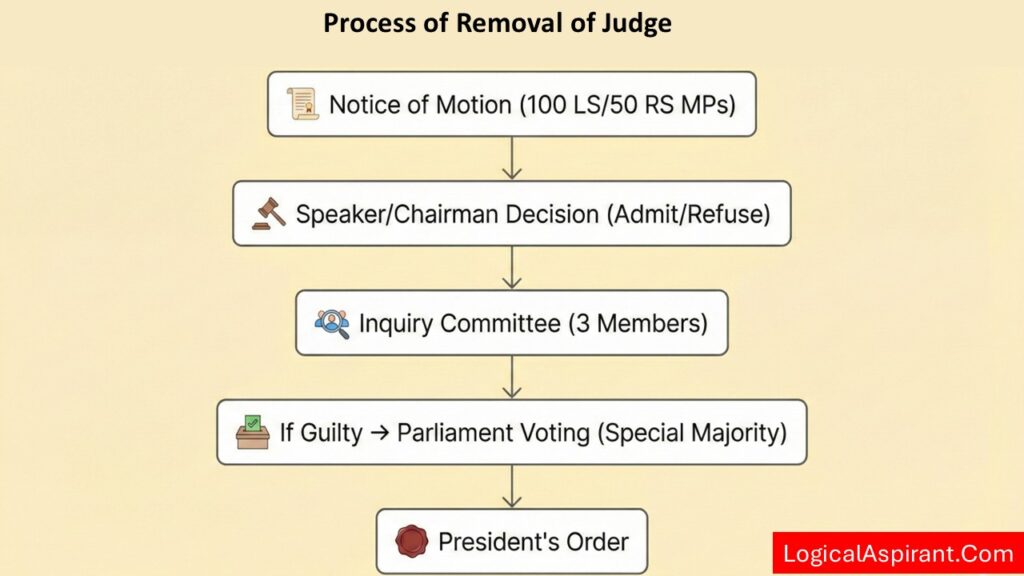
Judge removal process involves a legislative power and judicial inquiry. The process begins with a notice of motion, which requires a specific number of signatories depending on the House where it is introduced.
| House | Minimum Signatories Required | Authority to Submit To |
| Lok Sabha | 100 Members | Speaker |
| Rajya Sabha | 50 Members | Chairman |
If the motion is admitted by the Speaker/Chairman, they must constitute a Committee to investigate the grounds. The composition is mandatory under the Act:
| Member Position | Qualification Requirement |
| Chairperson/Member | The Chief Justice of India OR a Judge of the Supreme Court. |
| Member | A Chief Justice of a High Court. |
| Member | A distinguished jurist.² |
The Inquiry and Report
- The Committee frames definite charges and conducts an investigation.
- If the Committee finds the judge not guilty, the motion is not taken up further.
- If the Committee finds the judge guilty of misbehaviour or incapacity, the report is laid before both Houses of Parliament along with the motion.²
Parliamentary Voting
- The motion must be debated and passed by each House of Parliament.
- Majority Required: Special Majority, defined as:
- Majority of the total membership of that House.
- Majority of not less than two-thirds of the members of that House present and voting.¹
President’s Order
- Once the address is passed by both Houses in the same session, it is presented to the President.
- The President then issues the order removing the judge.¹
——————————————————————————————————————–
As Supreme Court critiqued the Secretary General of the Rajya Sabha regarding Justice Yashwant Varmal case. Lets understand Role of Secretary General of Rajya Sabha.
Role of Secretary General of Rajya Sabha
- The Secretary-General assists the Chairman, Rajya Sabha in discharging constitutional and statutory responsibilities.
- He holds rank equivalent to the Cabinet Secretary of India.
- He is responsible for the administrative head of the Rajya Sabha Secretariat, ensuring organization and smooth conduct of secretarial work of the House and its Committees.
- He is the principal advisor on parliamentary procedures to the Presiding Officers.
Points to remember
The President’s power to remove a judge is conditional. It can only be exercised after an address by both Houses of Parliament in the same session. The President cannot remove a judge unilaterally or solely on the PM’s advice.¹
The Constitution uses the word “Impeachment” only for the President (Article 61). For judges, the Constitutional term is “Removal” (Article 124). While “impeachment” is used colloquially in media, stick to “Removal” for technical accuracy in Prelims options.¹
Sources
1. Ministry of Law and Justice, Govt. of India. The Constitution of India (Article 124).
2. Department of Justice, Ministry of Law and Justice, Govt. of India. The Judges (Inquiry) Act.