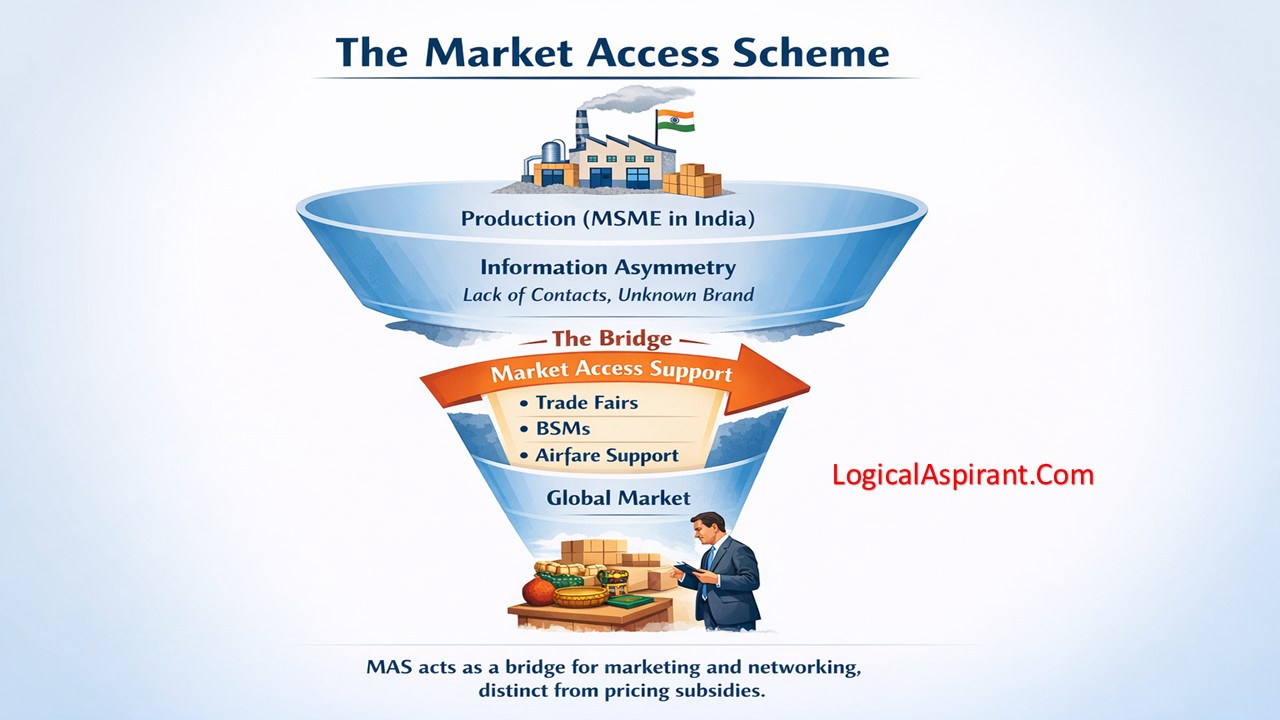
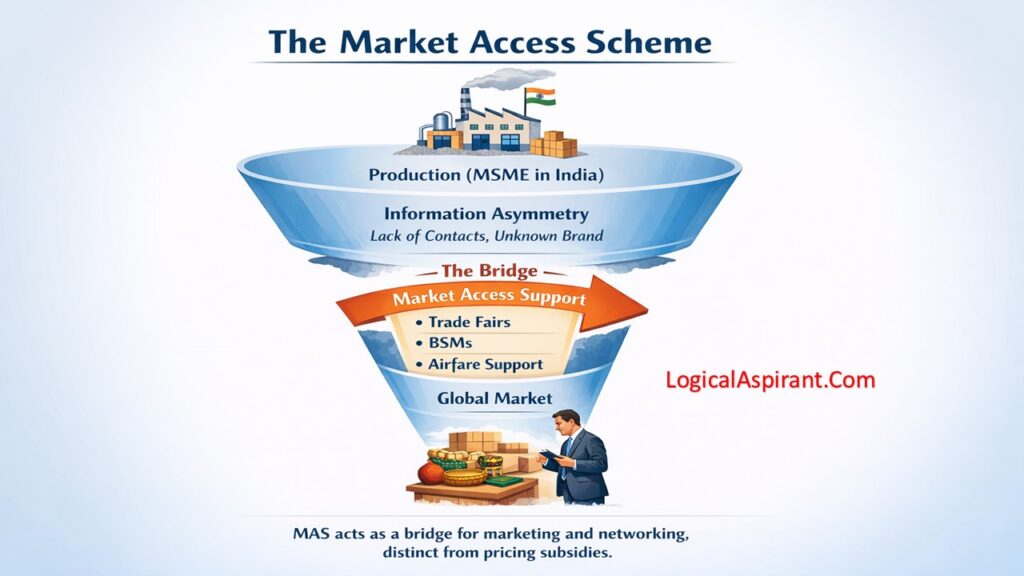
Govt. has launched the Market Access Support (MAS) Intervention under the Export Promotion Mission (EPM) to support Indian exporters in accessing foreign markets. The MAS Intervention operates under the NIRYAT DISHA sub-scheme, focuses on structured financial support for MSMEs and first-time exporters to participate in international trade fairs, Buyer-Seller Meets (BSMs), and exhibitions¹.
Market Access & Export Promotion
To understand this scheme, aspirants must know the difference between “Market Access” as a trade term and “Export Promotion” as a government activity, along World Trade Organization (WTO) rules regarding these.
As per WTO market access refers to the rules and commitments that govern how easily goods and services from one country can enter the market of another country. It is governed by the conditions imposed by the importing country.
- Tariff Barriers: Customs duties or taxes aimed at making imported goods more expensive.
- Non-Tariff Barriers (NTBs): Quotas, Sanitary & Phytosanitary Measures (SPS), Technical Barriers to Trade (TBT), or complex licensing procedures that restrict trade without taxes.
- Governments negotiate “Market Access” at forums like the WTO to reduce these barriers. However, even if barriers are low, exporters may fail due to a lack of visibility or connections. This is where Market Access Support (MAS) comes in it addresses the informational and marketing gap, not the regulatory gap.
Export Promotion vs. Export Subsidies (WTO Norms)
Under the WTO Agreement on Subsidies and Countervailing Measures (SCM Agreement), not all government support is treated equally²:
- Prohibited Subsidies (Red Box): Financial contributions linked to export performance (e.g., giving cash based on how many units are exported). These are generally viewed as trade-distorting.
- Permissible Support (Green/General Services): Governments can provide “General Services” to support exports without violating WTO norms. This includes funding for trade fairs, market research, marketing assistance, and infrastructure.
The MAS Intervention falls under this permissible category. It funds participation in events (marketing), not the price of the product. This makes it a WTO-compliant method of export promotion³.
| MAS Features | Details |
| Nodal Agencies | Jointly implemented by Dept. of Commerce, Ministry of MSME, and Ministry of Finance¹. |
| Target Group | MSMEs, First-time exporters, and Priority Sectors. |
| Mandatory Quota | A minimum of 35% participation is mandated for MSMEs in supported events to ensure inclusivity¹. |
| Airfare Support | Special provision for small exporters with an export turnover of up to ₹75 Lakh in the preceding year¹. |
| Activities Funded | Buyer-Seller Meets (BSMs), Mega Reverse BSMs (foreign buyers visiting India), and International Trade Fairs. |
Overall, the Market Access Support (MAS) Intervention under the Export Promotion Mission represents a strategic shift in India’s export policy from direct, trade-distorting subsidies to WTO-compliant, facilitative support.
Sources
1.PIB Delhi (Simulated): Government Launches Market Access Support Intervention under Export Promotion Mission, 31 Dec 2025.
2.World Trade Organization (WTO): Agreement on Subsidies and Countervailing Measures (SCM), Overview of provisions.