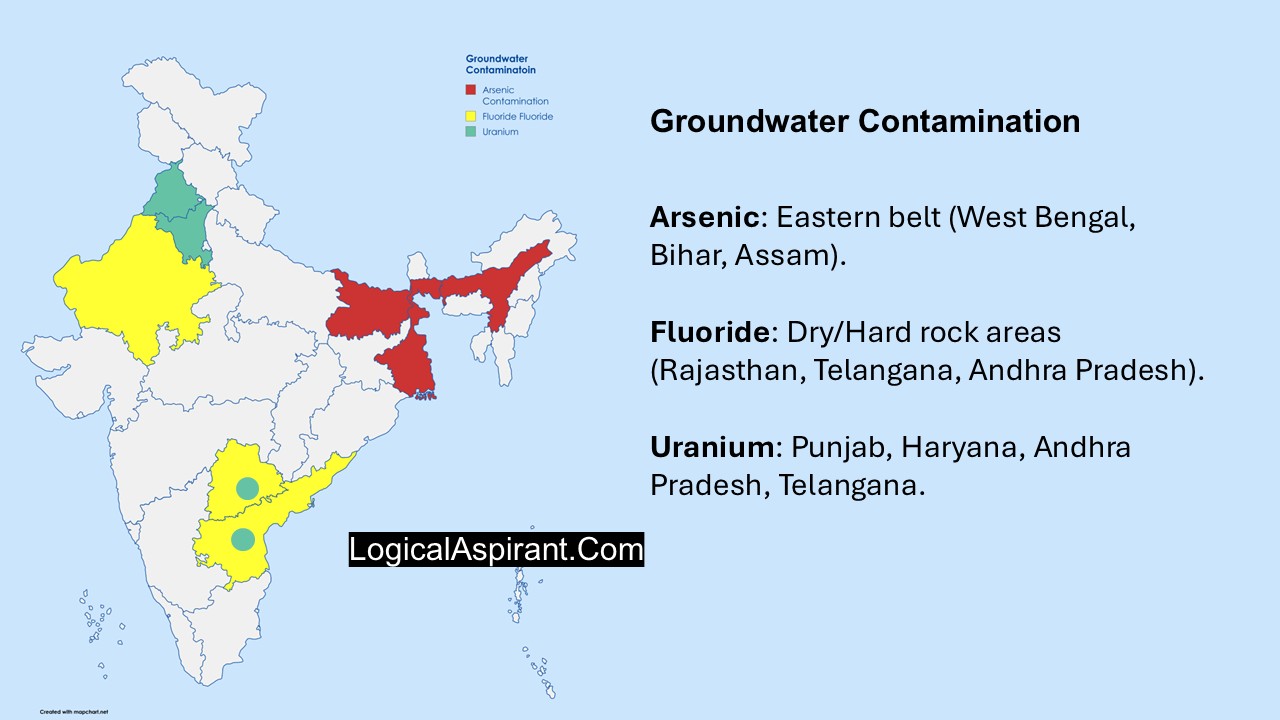
The Central Ground Water Board (CGWB) has released its Annual Ground Water Quality Report (2025). The report flags widespread contamination in states like Andhra Pradesh, Punjab, and Telangana, where Uranium, Fluoride, and Nitrate levels have exceeded safe limits.¹ “Ground water contamination of Andhra Pradesh” is also in news. UPSC has asked question on this in the 2013 CSE Prelims examination; therefore, developing a clear understanding of it is important.
***************************************************************************************************************Q Which of the following can be found as pollutants in the drinking water in some parts of India? (UPSC CSE Prelims 2013)
- Arsenic
- Sorbitol
- Fluoride
- Formaldehyde
- Uranium
Select the correct answer using the codes given below: (a) 1 and 3 only (b) 2, 4 and 5 only (c) 1, 3 and 5 only (d) 1, 2, 3, 4 and 5
Correct Answer: (c)
***************************************************************************************************************
Reasons for Groundwater Contamination
Groundwater is found in aquifers, underground layer of rock, sand, or gravel that holds and allows water to flow through it and can become contaminated becuase of two reasons –
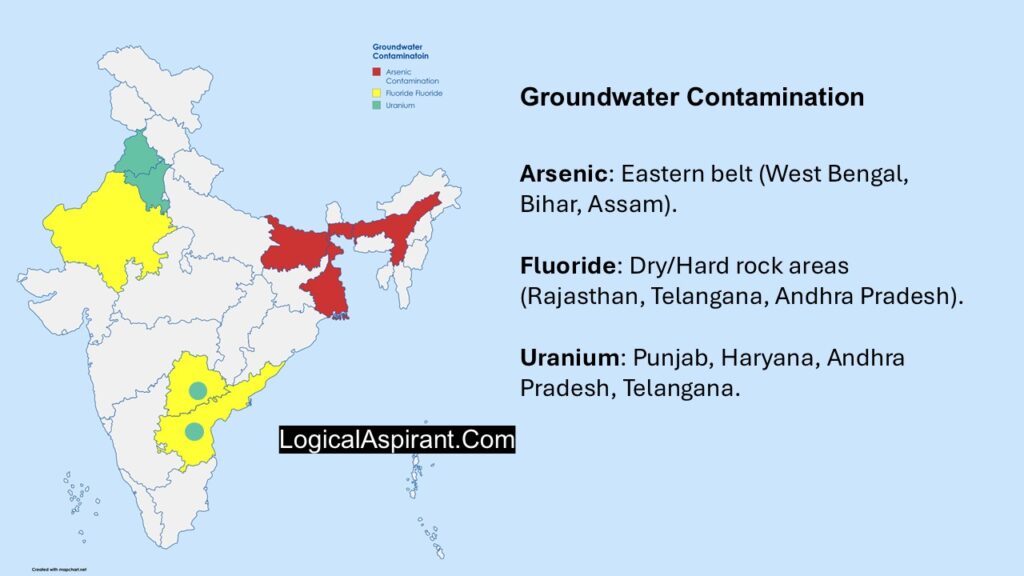
A. Natural Contamination (Geogenic) – As water remains in aquifers for long periods, it dissolves minerals from the surrounding rocks.
- Weathering of rocks naturally containing radioactive or toxic elements.
- Key Pollutants: Fluoride, Arsenic (sediments in Gangetic plains), and Uranium (granitic rocks).²
- Typically found in deep aquifers where water-rock interaction has occurred over a long duration.
B. Anthropogenic Contamination (Man-Made) – Human activities on surface leading leaching of pollutants into the ground.
- Unscientific disposal of industrial waste, sewage, and agricultural runoff.
- Key Pollutants: Nitrates (from fertilizers/urea), Heavy Metals, and persistent organic pollutants.
- Often affects shallow aquifers first as they are closer to the surface source.
Seasonal rainfall (Monsoon) recharges aquifers with fresh water. This natural process dilutes the concentration of dissolved salts and pollutants, temporarily lowering levels of Fluoride and Salinity.¹
| Pollutant | Source & Mechanism | Acceptable Limit | Health Impact |
| Uranium | Geogenic: Radioactive decay in granitic rocks/pegmatites. Aggravated by bicarbonate and nitrate levels.² | 0.03 mg/L (30 parts per billion) | Nephrotoxicity (Kidney damage). It is a chemical toxin more than a radiological hazard in this context.³ |
| Fluoride | Geogenic: Weathering of rocks. Prevalent in “Hard Rock Aquifers” (granite/gneiss). | 1.0 – 1.5 mg/L | Fluorosis: Dental (discoloration) and Skeletal (bone deformation).² |
| Nitrate | Anthropogenic: Leaching from nitrogen fertilizers (urea) and septic tanks/sewage. | 45 mg/L | Methemoglobinemia (Blue Baby Syndrome): Reduces blood’s oxygen-carrying capacity in infants.³ |
| Arsenic | Geogenic: Sediments in the Ganga-Brahmaputra basin. | 0.01 mg/L (10 parts per billion) | Skin lesions, Blackfoot disease, and Cancer.³ |
Points to remember
Boiling of contaminated water kills biological pathogens (bacteria/viruses). However, it concentrates chemical pollutants like Arsenic, Fluoride, and Uranium. As water evaporates, the volume decreases, but the amount of mineral remains the same, increasing the concentration per liter.³
In India, Uranium contamination is predominantly Geogenic (natural), originating from granitic rocks. However, human activities like over-extraction (drawing deep water) and nitrate pollution (which chemically mobilizes Uranium) aggravate the issue.²
Sources
1. Central Ground Water Board (CGWB), Ministry of Jal Shakti, Govt. of India. Ground Water Year Book / Quality Reports.
2. Bureau of Indian Standards (BIS). Indian Standard Drinking Water – Specification (Second Revision) IS 10500:2012 (Amendments).
3. World Health Organization (WHO). Guidelines for drinking-water quality: Fourth edition incorporating the first addendum.