With recurrent outbreaks in West Bengal, Nipah Virus (NiV) is again in news. Considering the fact that UPSC frequently asks MCQs on viruses in prelims exam, it is essential to understand NiV in terms of its transmission, survivability outside the host, and other key aspects relevant for the examination.
WHO has designated it as a Priority Disease due to its epidemic potential and lack of effective preventive measures.
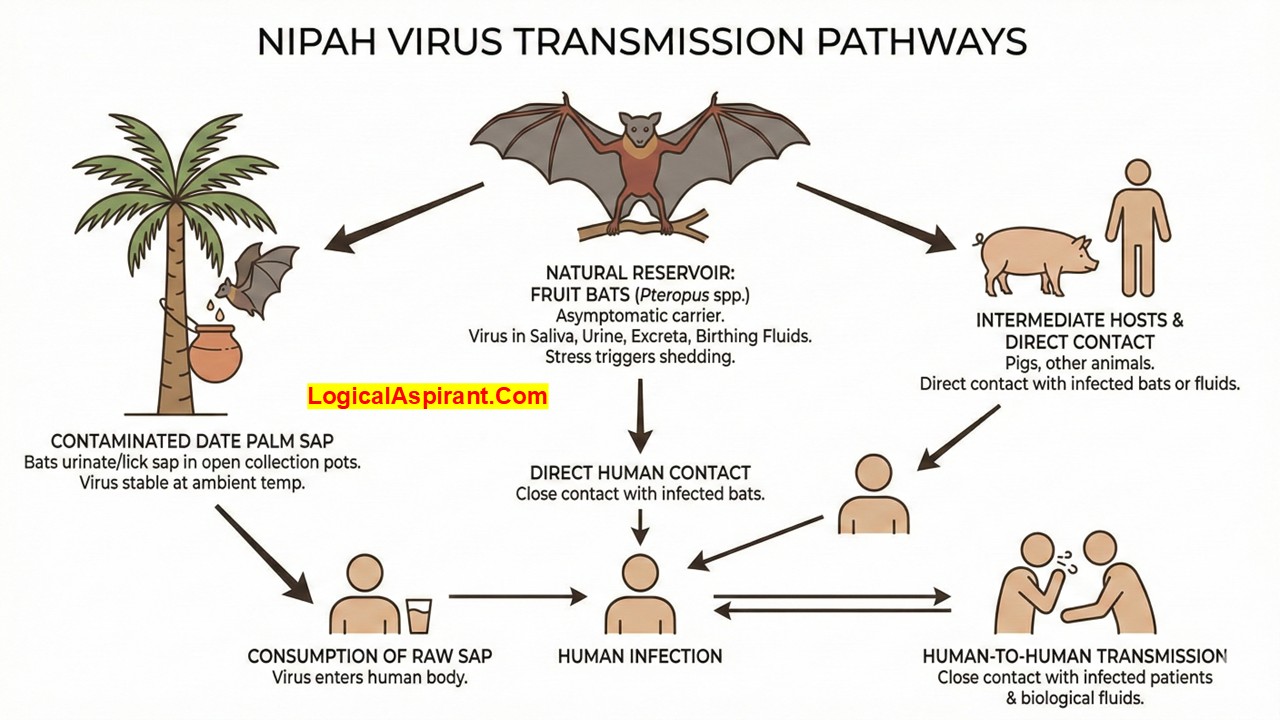
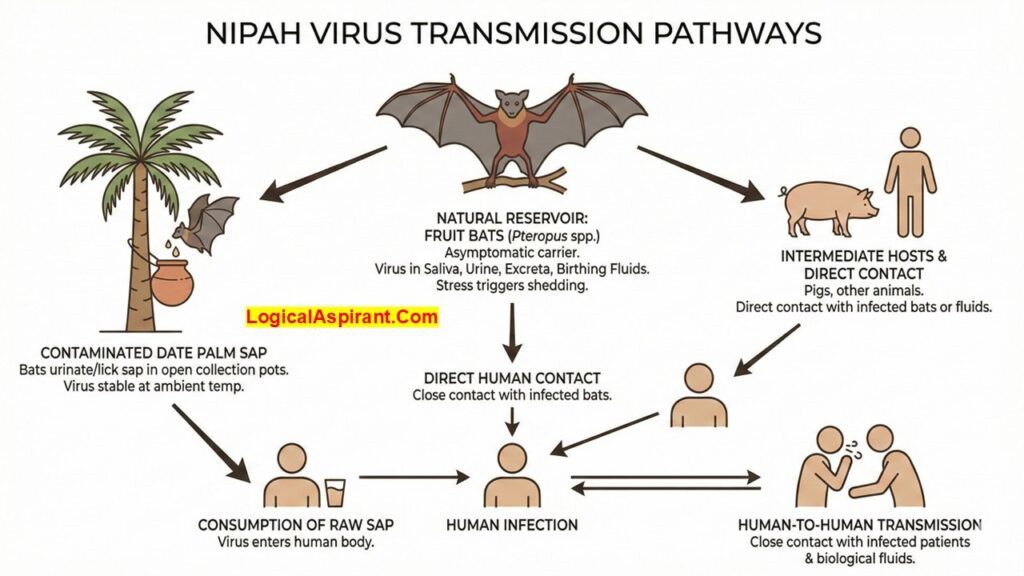
Transmission Cycle of Nipah Virus
- Nipah is a zoonotic virus (transmitted from animals to humans).
- Fruit bats of the Pteropus species (flying foxes) are the natural reservoir of the Nipah virus. They harbour the virus without falling ill. The virus is present in their saliva, urine, excreta, and birthing fluids.
- Their unique immune system and high body temperature due to flight allow bats to survive the virus asymptomatically, while stress conditions trigger viral shedding, leading to outbreaks.
- Outbreaks in India (West Bengal/Bangladesh border and sometimes in Kerala) are linked to humans consuming raw date palm sap.
- Bats perch on the clay pots used to collect sap at night. They urinate into the open pots or lick the sap, depositing saliva. Since the sap is often consumed raw (without boiling), the virus enters the human body directly.
- Transmission occurs through direct contact with infected bats, and sometimes through pigs acting as intermediate hosts.
- Close contact with infected patients can lead to transmission; the virus can spread from human to human.
- The virus is relatively stable in biological fluids and can survive for several days in fruit juice or sap at ambient temperatures (20°C–30°C).
Clinical Features
- Incubation (duration between exposure to the pathogen and the onset of clinical symptoms): Typically 4–14 days, though instances up to 45 days have been recorded.
- Symptoms ranges from fever, headache, and myalgia to severe encephalitis (brain inflammation) and coma within 24-48 hours.
- High Case Fatality Rate (CFR) estimated between 40% and 75%.
Treatment & Prevention
- No licensed vaccine or specific antiviral treatment exists for humans or animals.
- Management relies strictly on supportive care.
- Diagnostics: RT-PCR (throat swabs, CSF) and ELISA.
——————————————————————————————————————–
UPSC tends to ask about viruses that are frequently in the headlines. Earlier UPSC has asked questions on Zika Virus, H1N1 virus.
UPSC Prelims 2017
Q: Consider the following statements:
- In tropical regions, Zika virus disease is transmitted by the same mosquito that transmits dengue.
- Sexual transmission of Zika virus disease is possible.
Which of the statements given above is/are correct?
(a) 1 only
(b) 2 only
(c) Both 1 and 2
(d) Neither 1 nor 2
Answer: (c)
——————————————————————————————————————–
UPSC Prelims 2015
Q: H1N1 virus is sometimes mentioned in the news with reference to which one of the following diseases? (a) AIDS (b) Bird flu (c) Dengue (d) Swine flu
Answer: (d)
——————————————————————————————————————–
UPSC Prelims 2021
Q: Consider the following statements:
- Adenoviruses have single-stranded DNA genomes whereas retroviruses have double-stranded DNA genomes.
- Common cold is sometime caused by an adenovirus whereas AIDS is caused by a retrovirus.
Which of the statements given above is/are correct?
(a) 1 only (b) 2 only (c) Both 1 and 2 (d) Neither 1 nor 2
Answer: (b)