On January 12, 2026, ISRO’s Polar Satellite Launch Vehicle (PSLV-C62) failed to place its payloads the primary EOS-N1 satellite and 15 other small satellites into Sun-Synchronous Polar Orbit (SSPO). As a UPSC aspirants, you must go beyond headlies and understand the core concepts like Sun-Synchronous Polar Orbit, which are very important for prelims.
Analysis of the Failure
The mission proceeded normally through the first two stages. However, a “roll rate disturbance” occurred during the Third Stage (PS3) the penultimate stage powered by a solid-fuel motor. This anomaly led to a flight path deviation, preventing the vehicle from reaching the velocity required for its 505 km Sun-Synchronous Polar Orbit (SSPO).
Notably, this is the second consecutive failure involving the PS3 stage, following the PSLV-C61 mission in May 2025.
Understanding the Orbits
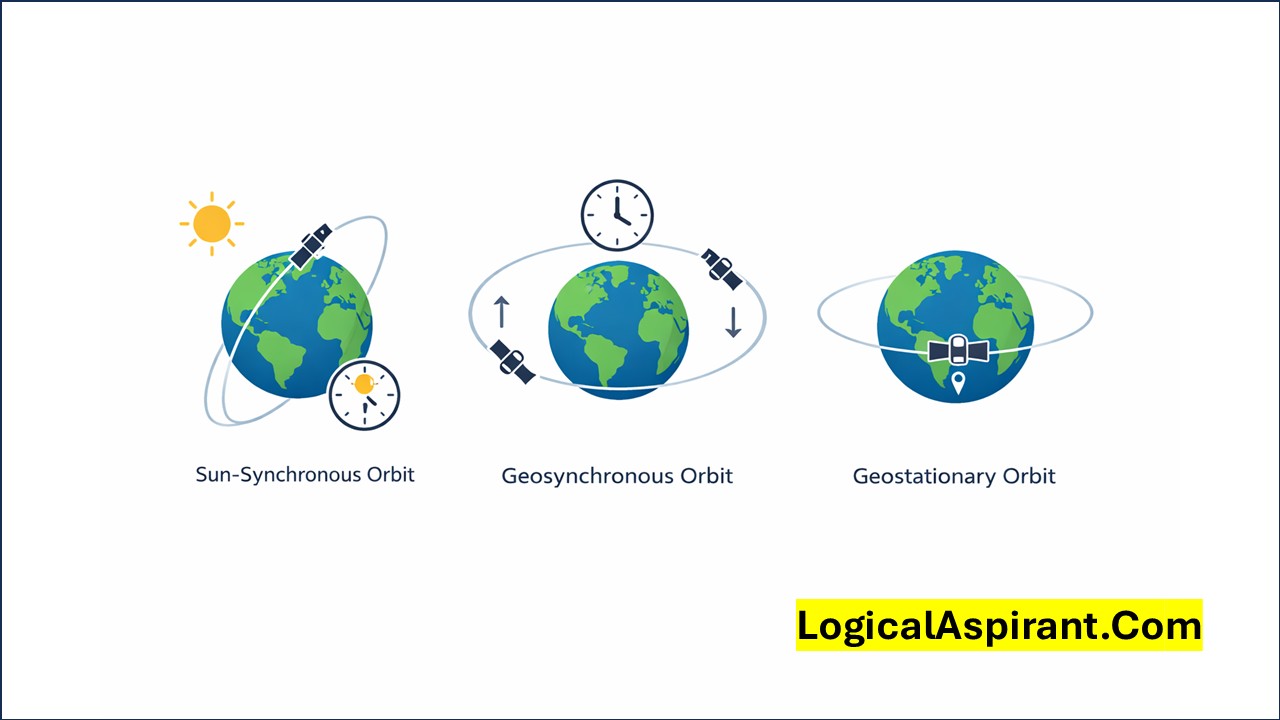
Satellites are placed in specific orbits based on their mission objectives. The three most relevant types for the exam are:

| Orbit Type | Altitude | Orientation | Primary Use |
| Sun-Synchronous (SSPO) | 200 – 1,000 km | Polar (North-South) | Earth Observation: Passes over a spot at the same local solar time, ensuring consistent lighting for imagery. |
| Geosynchronous (GSO) | ~35,786 km | Inclined to Equator | Regional Coverage: Matches Earth’s rotation; satellite appears at the same sky position at the same time daily. |
| Geostationary (GEO) | ~35,786 km | Exactly on Equator | Communication/TV: Appears stationary over a fixed point on Earth. |
Sun-Synchronous Polar Orbit (SSPO)
SSPO is a specific polar orbit where the satellite’s orbital plane rotates (precesses) at the same rate as Earth’s orbit around the Sun. It provides “constant illumination,” which is vital for DRDO’s EOS-N1 surveillance satellite to capture high-quality images with the same shadow angles every day.
Geostationary and Geosynchronous Orbit
While often used interchangeably, there is a technical distinction:
- Geostationary orbit is a circular orbit directly above the equator. The satellite is “locked” over a single spot on Earth.
- Geosynchronous has the same orbital period (24 hours) but may be tilted (inclined). From Earth, a Geosynchronous satellite might trace a “figure-eight“ pattern in the sky.
All Geostationary orbits are Geosynchronous, but not all Geosynchronous orbits are Geostationary.
GSLV(Geosynchronous Satellite Launch Vehicle) launch vehicle is used to place heavy communication satellites (INSAT and GSAT communication satellites) into geosynchronous transfer orbit (GTO) from here they move to geostationary orbit
GSLV is a three-stage rocket
- First Stage – Solid fuel (with liquid strap-on motors)
- Second Stage – Liquid fuel (Vikas engine)
- Third Stage – Cryogenic engine (high efficiency)
The key feature of GSLV is its cryogenic upper stage, which uses liquid hydrogen and liquid oxygen. This makes GSLV more powerful and efficient than PSLV for lifting heavier payloads to higher orbits.
The Role of PSLV
The PSLV is famously known as the “Workhorse of ISRO” because of its reliability (historically >93% success rate) and versatility.
It is a four-stage vehicle using alternating solid and liquid fuel.
- Stage I – Solid Propellant
- Stage II – Liquid Propellant
- Stage III – Solid Propellant
- Stage IV – Liquid Propellant
It was originally designed to place IRS (Indian Remote Sensing) satellites into SSPO. However, its robust design has allowed it to launch missions like Mangalyaan (Mars) and Chandrayaan-1 (Moon).
UPSC Prelims PYQ on these concepts
Q. With reference to India’s satellite launch vehicles, consider the following statements: (2018 UPSC CSE Prelims)
- PSLVs launch the satellites useful for Earth resources monitoring whereas GSLVs are designed mainly to launch communication satellites.
- Satellites launched by PSLV appear to remain permanently fixed in the same position in the sky, as viewed from a particular location on Earth.
- GSLV Mk III is a four-staged launch vehicle with the first and third stages using solid rocket motors; and the second and fourth stages using liquid rocket engines.
Which of the statements given above is/are correct?
(a) 1 only
(b) 2 and 3 only
(c) 1 and 2 only
(d) 1, 2 and 3
Answer : (a)
Q. Satellites used for telecommunication relay are kept in a geostationary orbit. A satellite is said to be in such an orbit when: (2011 UPSC CSE Prelims)
- The orbit is geosynchronous.
- The orbit is circular.
- The orbit lies in the plane of the Earth’s equator.
- The orbit is at an altitude of 22,236 km.
Select the correct answer using the codes given below:
(a) 1,2 and 3 only
(b) 1,3 and 4 only
(c) 2 and 4 Only
(d) 1, 2, 3 and 4
Answer: (a) Statements 1,2 and 3 are correct.