Venezuelan has been in news due to US – Venezuela conflict and because of its oil reserves. The Orinoco Oil Belt is a vast petroleum-rich region in eastern Venezuela containing some of the world’s largest reserves of extra-heavy crude oil. While Venezuela holds the world’s largest proven oil reserves (surpassing even Saudi Arabia), its oil is not the same “liquid gold” found in the Middle East. It is predominantly “Heavy” and “Sour.”
For UPSC Prelims, this news is a trigger to understand the qualitative classification of crude oil. Not all crude oil is equal; its economic value and refining complexity depend heavily on two scientific parameters: API Gravity (density) and Sulfur Content (purity).
Crude oil classification
Crude oil is classified based on how difficult it is to refine into useful products like petrol and diesel. This classification relies on two main pillars:
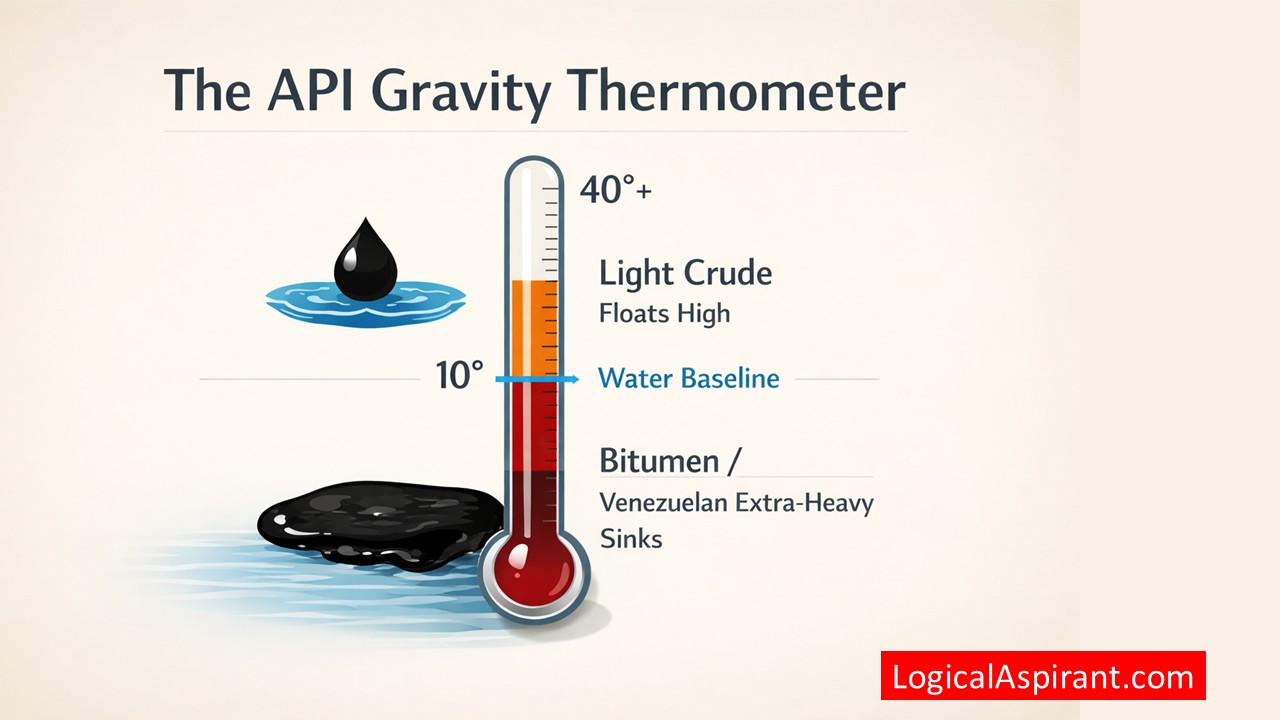
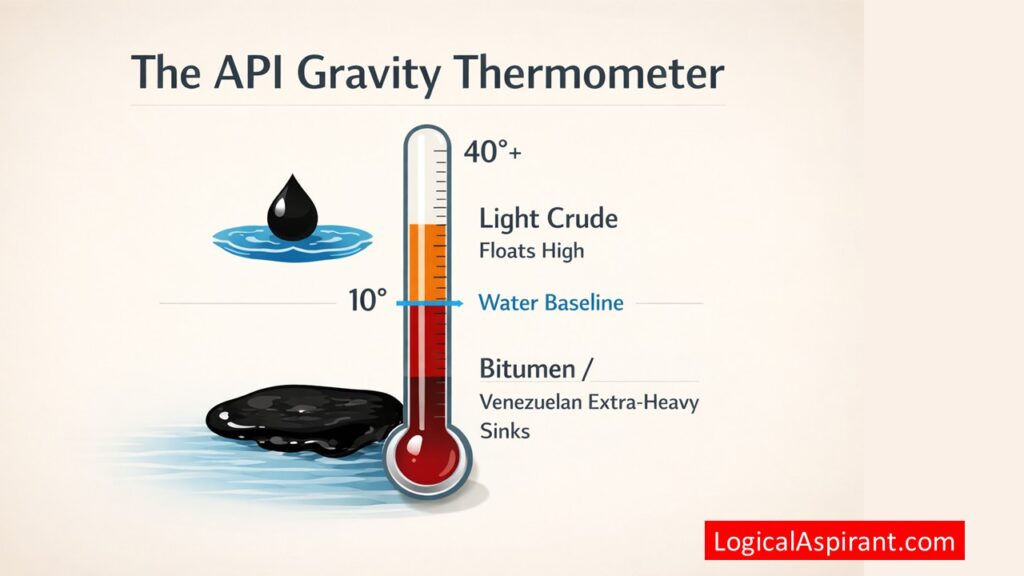
A. API Gravity (The “Weight” Scale) The American Petroleum Institute (API) Gravity is a scale that measures how heavy or light a petroleum liquid is compared to water.
- The Inverse Rule: The scale works in reverse to density.
- High API (> 31.1°): Light Crude. It is thin, flows easily (low viscosity), and floats on water. It is valuable because it yields more petrol/diesel with less refining.
- Low API (< 22.3°): Heavy Crude. It is thick, viscous (like molasses), and contains complex hydrocarbon chains.
- Extra Heavy (< 10°): This oil is heavier than water and will sink. Venezuelan oil often falls here.
B. Sulfur Content (The “Taste” Test)
- Sweet Crude: Contains less than 0.5% sulfur. It is called “sweet” because 19th-century prospectors would taste the oil to check quality (low sulfur tastes sweet/pleasant). It is cleaner and cheaper to refine.
- Sour Crude: Contains more than 0.5% sulfur. It is highly corrosive and requires expensive processing (“desulfurization”) to remove impurities before it can be used.
Other Important Information| UPSC Prelims
- Since Venezuelan heavy crude is too thick to flow through pipelines, it must be mixed with lighter hydrocarbons (like naphtha) to transport it. This mixture is often called Diluted Crude Oil (DCO).
- Specialised refinery units needed to process heavy oil. They “crack” the long, heavy carbon chains into shorter ones. The US Gulf Coast (Texas/Louisiana) has the world’s largest concentration of these complex refineries, creating a natural economic link between Venezuelan production and US processing.
- Brent vs. WTI:
- Brent Crude: Extracted from the North Sea. It is Light and Sweet. Serves as the global price benchmark.
- WTI (West Texas Intermediate): Extracted in the US. Even lighter and sweeter than Brent.
You must remember that “Higher API doesn’t mean Heavier Oil”: This is the most common misunderstanig. Remember, it is an inverse relationaship. Higher API means lighter oil.
Prelims Relevant statement-based question
- Statement 1: Crude oil with an API gravity of less than 10 degrees floats on water. (False – it sinks).
- Statement 2: Sweet crude oil is defined by a low content of carbon. (False – it is defined by low sulfur)
PYQ UPSC Prelims
UPSC has already asked one question related to this topic in 2011 CSE Prelims exam. Therfore conceptual understanding of this issue is very much important for exam.
Question: In the context of global oil prices, “Brent crude oil” is frequently referred to in the news. What does this term imply?
Statements:
- It is a major classification of crude oil.
- It is sourced from the North Sea.
- It does not contain sulphur.
Which of the statements given above is/are correct?
A. 2 only
B. 1 and 2 only
C. 1 and 3 only
D. 1, 2 and 3
Correct answer: B, Brent crude does contain sulphur (although at relatively low levels compared to heavier crudes), so it is not completely sulphur-free.