The recent discovery of new frog species in Arunachal Pradesh highlights the immense biological richness of the Himalaya Biodiversity Hotspot.
For UPSC Prelims, you must look beyond the news item. The exam often tests the criteria and locations of these hotspots rather than specific species names.
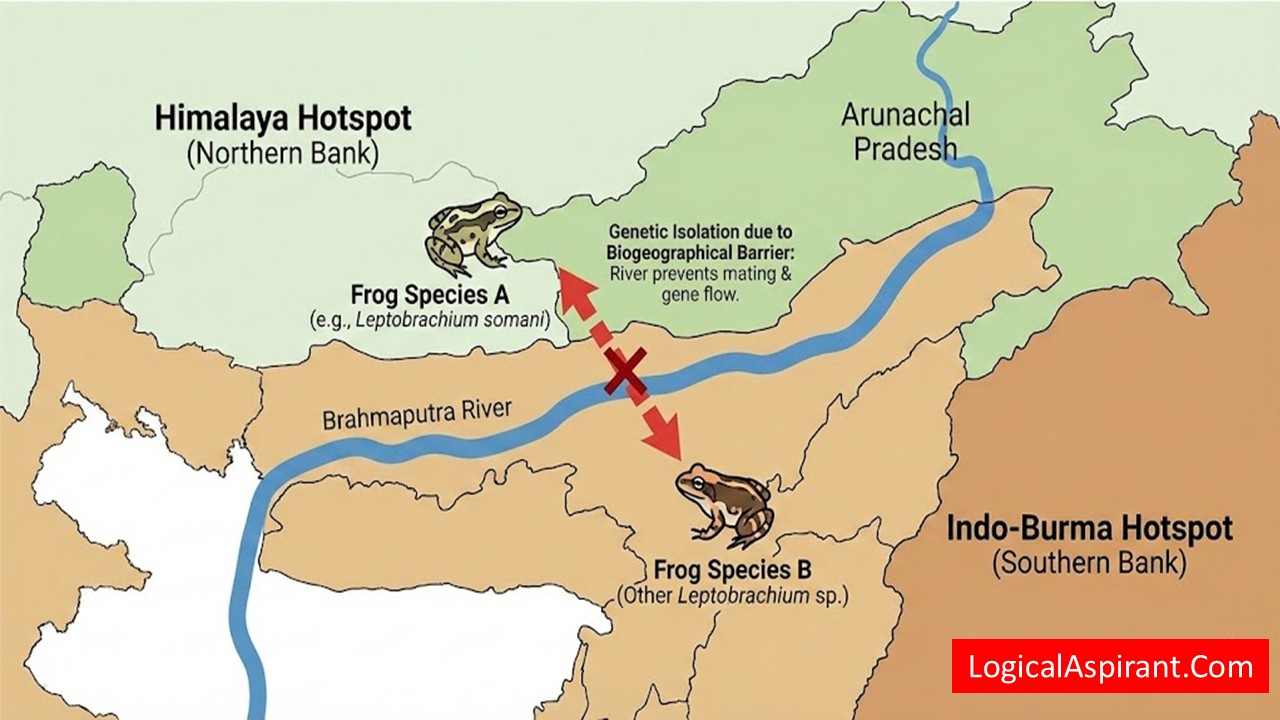
The most exam-relevant aspect of this news is the role of the Brahmaputra River as a Biogeographical barrier to gene flow.
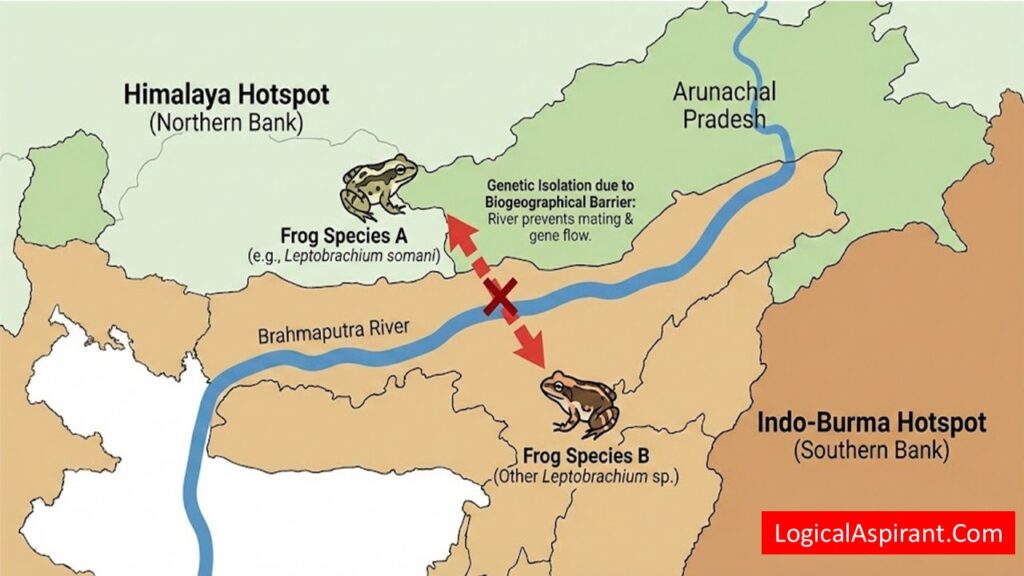
What is a Biogeographical Barrier?
Large rivers often stop species from crossing over. Over thousands of years, populations on opposite banks evolve differently because they cannot mate with each other (genetic isolation).
The study found that the two new species (Leptobrachium somani and Leptobrachium mechuka) are restricted strictly to the northern bank of the Brahmaputra. In contrast, all other known members of this genus in the region are found on the southern bank.
Brahmaputra system has actively shaped the distribution and diversification of amphibians in the region.
What is a Biodiversity Hotspot?
A Biodiversity Hotspot is a region that is biologically rich and deeply threatened. The concept was coined by Norman Myers in 1988.
To qualify as a hotspot, a region must meet two strict criteria (as defined by Conservation International and adopted by IUCN/MoEFCC):
- High Endemism: It must contain at least 1,500 species of vascular plants (> 0.5% of the world’s total) as endemics (species found nowhere else on Earth).
- High Threat: It must have lost at least 70% of its primary native vegetation.
A region can have high biodiversity (like the Amazon), but if it hasn’t lost 70% of its habitat, it is not a hotspot. It is a “High Biodiversity Wilderness Area.” Hotspots are areas in crisis.
There are currently 36 recognized Biodiversity Hotspots globally.
India’s Biodiversity Hotspots
India is home to 4 of these 36 global hotspots.
| Hotspot Name | Indian Region | Global Coverage (Countries sharing this hotspot) |
| 1. Himalaya | J&K, Ladakh, Himachal, Uttarakhand, Sikkim, Arunachal, N. Bengal | Pakistan, Nepal, Bhutan, China (Tibet), Myanmar. |
| 2. Indo-Burma | North-East India (excluding parts of Assam), Andaman Islands | Myanmar, Thailand, Cambodia, Vietnam, Laos, Southern China. |
| 3. Sundaland | Nicobar Islands | Indonesia, Malaysia, Singapore, Brunei, Philippines. |
| 4. Western Ghats & Sri Lanka | Western Ghats (6 States: Guj, Mah, Goa, Kar, Ker, TN) | Sri Lanka (The hotspot jumps across the ocean). |
Other important concepts relevant for UPSC Prelims Exam
- “Megadiverse Countries” vs. “Hotspots” – India is one of the 17 Megadiverse Countries (a political grouping by Like-Minded Megadiverse Countries).This is different from a Biodiversity Hotspot (a scientific/conservation designation). Do not interchange them.
- You may often assume Andaman & Nicobar fall under the same hotspot but they do not.
- Andaman falls under Indo-Burma hotspot.
- Nicobar falls under Sundaland hotspot.
- Only Western Ghats are a hotspot Not the Eastern Ghats