A groundbreaking study published in People and Nature (a journal by the British Ecological Society) has used ancient Marathi literature to prove that the savannas of Western Maharashtra are ancient natural ecosystems, not “degraded forests” as previously believed.
Savannas vs. Degraded Forests
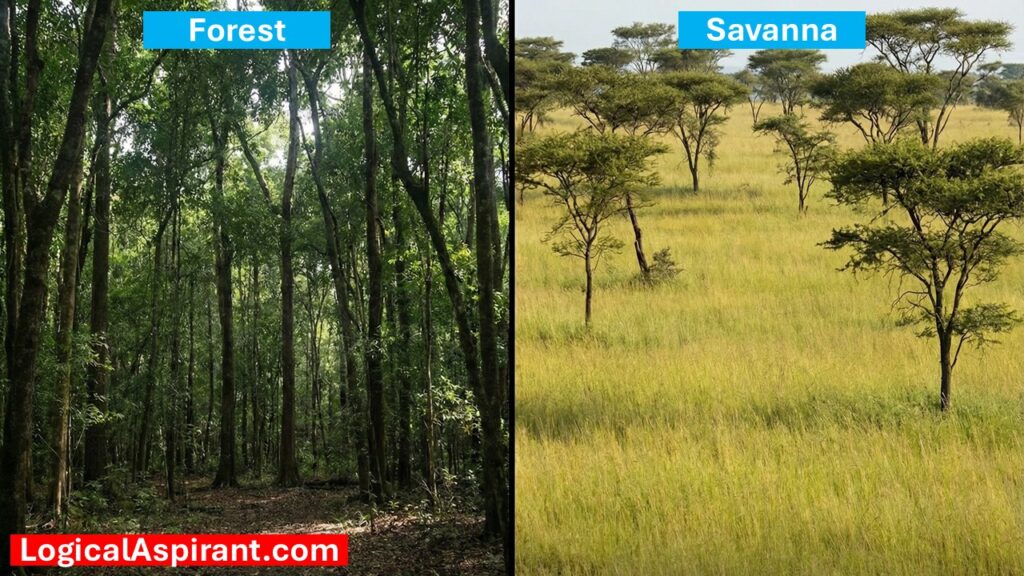
The central debate is about Biome Identity: Is a piece of land a “broken” forest that needs fixing (planting trees), or is it naturally supposed to be grassy with few trees?
What is a Savanna?
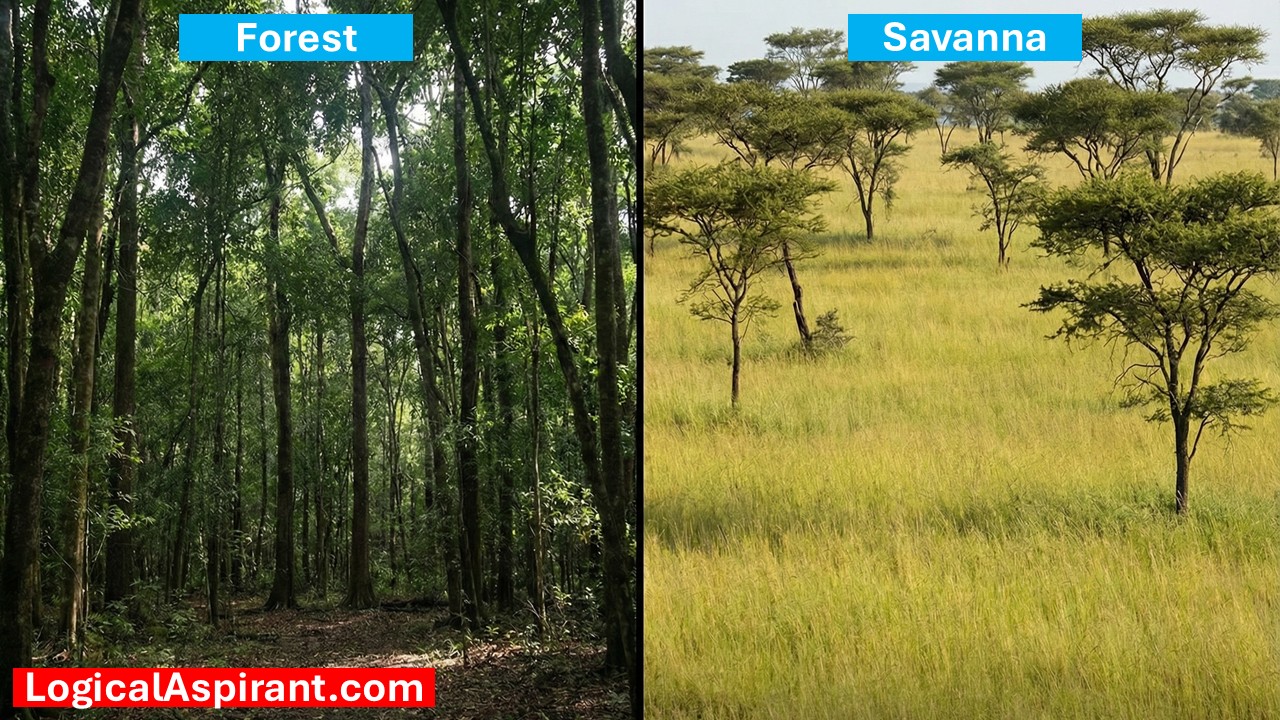
- A distinct biome defined by a continuous grass layer co-existing with scattered trees. It is not a forest with missing trees.
- The system is maintained by fire and herbivory (grazing animals). These are not “disturbances” here; they are essential processes that stop the savanna from turning into a closed-canopy forest.
- Plants here are adapted to drought and fire (e.g., thick bark, large underground storage roots).
Correcting the ‘Wasteland’ Narrative
- Historically, British forestry viewed any land without dense trees as “degraded” or “wasteland.” This led to policies of afforestation (planting trees) in naturally open habitats.
- The study uses texts like the Lilacharitra (13th century) to show that species like Bor and Babul (thorny savanna trees) and vast grasslands existed in Maharashtra 700+ years ago, long before modern human deforestation. This proves these landscapes are ancient and natural.
Other Important Related Concepts UPSC May Test
- Open Natural Ecosystems (ONEs): Open Natural Ecosystems are ancient, natural, biodiverse landscapes that are open by nature not deforested lands waiting to become forests. These includes savannas, grasslands, shrublands, and rocky outcrops. They cover ~10-15% of India but are often legally classified as “Wastelands.”
- Role of Fire in Ecosystem Maintenance
- Forests: Closed canopy (sunlight doesn’t hit ground easily), shade-loving plants, fire is destructive.
- Savannas: Open canopy (sunlight hits ground), sun-loving (C4) grasses, fire is often necessary for regeneration.
- British Ecological Society – Oldest ecological society in the world. The organization holds its Annual Meeting every December and launched its interdisciplinary journal People and Nature in 2018, which focuses on research exploring the complex, two-way relationships between human societies and the natural world.
Common Confusions aspirants may have
“Afforestation” is always good.
Planting trees in a natural grassland/savanna is harmful. It destroys the habitat of species like the Great Indian Bustard and Blackbuck.
Statement-Based Questions
- Statement 1: Fire is always detrimental to ecosystem health. (False – essential for Savannas).
- Statement 2: Western Maharashtra savannas are a result of colonial deforestation. (False – they are ancient natural systems).