Recent geopolitical tensions have seen major global powers restricting the export of Rare Earth Elements (REEs).
These elements are often called the “vitamins of modern industry” because, like vitamins in the human body, they are needed in tiny quantities but are absolutely essential for the “health” (functioning) of high-tech devices from smartphones to fighter jets. The core concept here is Strategic Criticality: a resource that is economically vital but suffers from high supply risk.
What are Rare Earth Elements?
REEs are a group of 17 chemically similar metallic elements. They appear in the Periodic Table as:
- The Lanthanides (15 elements): Atomic numbers 57 (Lanthanum) to 71 (Lutetium).
- And Scandium and Yttrium. (Included because they have similar chemical properties and are often found in the same ore deposits).
Why are they called “Rare”?
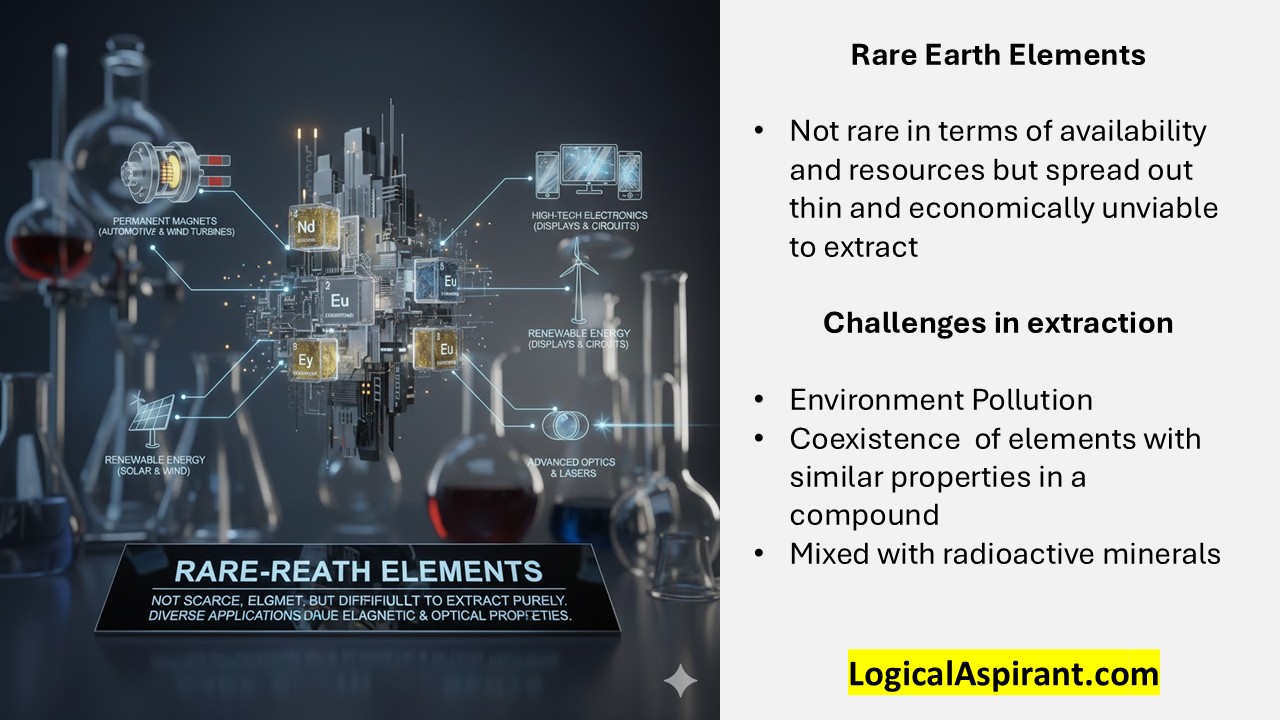
This is the most common confusion. They are not rare in terms of abundance. For example, Cerium is more abundant in the Earth’s crust than Copper or Lead.
- The “Rarity” explained: They are rarely found in concentrated pure ores. They are usually dispersed (mixed) with other elements.
- Because they are chemically very similar, separating them from each other is extremely difficult, energy-intensive, and generates toxic chemical waste.
Based on atomic weight divided in two categories Light and Heavy REEs
- Light Rare Earths (LREEs): (e.g., Lanthanum, Cerium, Neodymium). These are more abundant and less valuable.
- Heavy Rare Earths (HREEs): (e.g., Dysprosium, Terbium). These are less common, harder to source, and crucial for high-performance applications like military-grade magnets and lasers. China dominates the HREE market almost exclusively.
Key Properties & Uses
- Magnetic: The strongest permanent magnets (Neodymium magnets) resist demagnetization at high heat (critical for EV motors and wind turbines).
- Luminescent: Used in LED screens and lasers (e.g., Europium for red color in TVs).
- Electrochemical: Used in rechargeable batteries.
Related Concepts UPSC May Test
- Critical Minerals: REEs are a subset of “Critical Minerals”. Critical minerals are essential for economic development and national security (e.g., Lithium, Cobalt, REEs), face supply chain risks.
- Urban Mining: Since REE extraction is dirty and difficult, “Urban Mining” refers to recovering these metals from e-waste (discarded electronics). India is pushing for this under its Circular Economy policies.
- KABIL (Khanij Bidesh India Ltd): A joint venture company set up by the Ministry of Mines to ensure the supply of critical minerals by acquiring assets overseas (e.g., in Australia or Argentina).
Common Confusions
“India has no Rare Earths.” – No. India has the 5th largest reserves in the world (approx. 6.9 million tonnes). However, India’s production is very low. We have the rocks; we lack the refined processing capacity.“They are radioactive.”– No. The REEs themselves are stable. However, they are almost always found alongside Thorium and Uranium (radioactive elements). This makes mining them a radiological hazard, which is why the Department of Atomic Energy (DAE) regulates them in India.“Semiconductors are Rare Earths.”– No. Semiconductors primarily use Silicon and Germanium. REEs are used in components (like speakers/magnets) inside the device, not the chip itself.
Other important facts on REEs
Monazite is the primary ore for REEs in India. Found in beach sands (placer deposits) of Kerala, Tamil Nadu, and Odisha. Since Monazite contains Thorium (nuclear fuel), private mining is restricted; IREL (India) Limited (a PSU) controls it.
China controls roughly 60% of mining but nearly 85-90% of processing (separation). Major non-China reserves: Vietnam, Brazil, Russia, India.
Specific Applications of REE – Neodymium is used in Permanent magnets (EVs) and Yttrium in Superconductors and lasers.
Rare Earth Elements are the backbone of the green energy transition and defense technology. While India possesses significant reserves in its coastal Monazite sands, the challenge lies in developing the complex “midstream” processing capabilities to reduce import dependence.