The following articles and terms have been in the news and are highly relevant for the UPSC CSE Prelims Exam. This blog post shall be updated throughout the January month based on relevant news articles and information covered in reputed newspapers and GOI announcements.

January 2026 News in Brief | UPSC Prelims
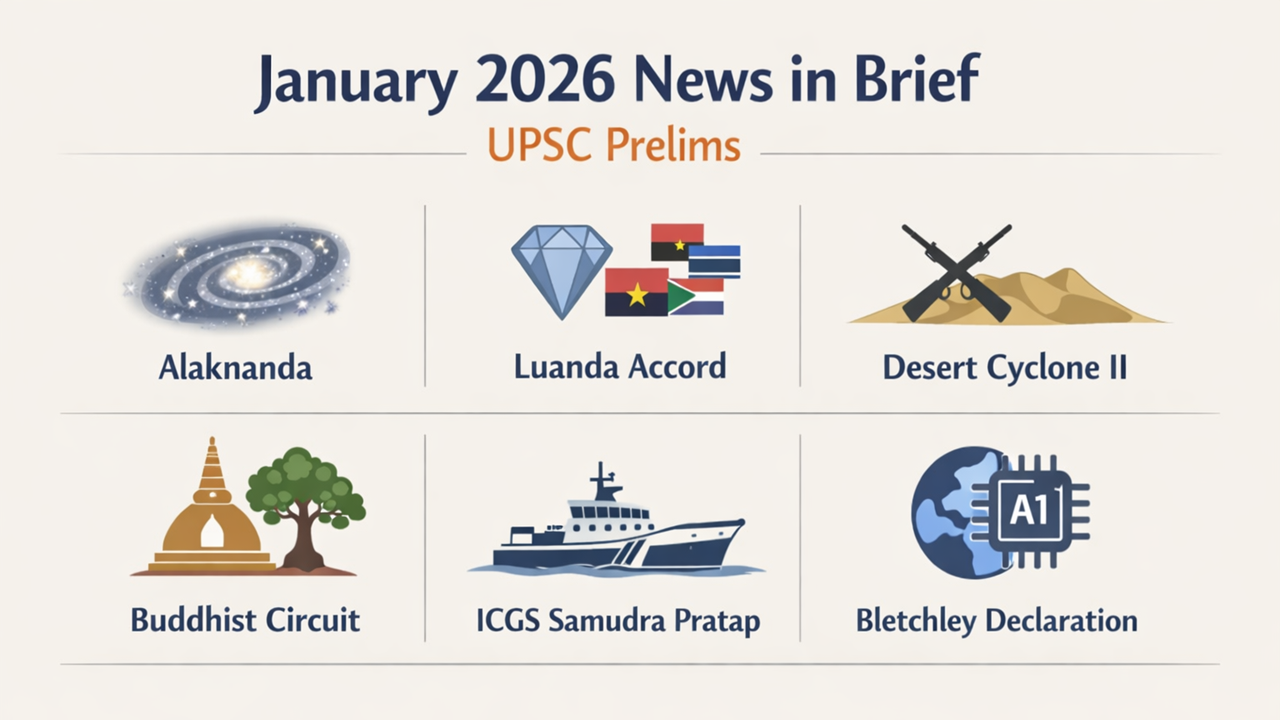
Alaknanda
Indian astronomers discovered Alaknanda, the second farthest known spiral galaxy, using JWST (James Webb Space Telescope). Alaknanda existed ~1.5 billion years after the Big Bang, much earlier than current galaxy-formation models allow.
Luanda Accord
The TATA Group is entering the lab-grown diamond segment with its brand “beYon” at a time when global demand for such diamonds has sharply declined, despite many companies exiting the segment due to poor market conditions.
Luanda Accord – Diamond-producing countries Angola, Botswana, the Democratic Republic of Congo, Namibia, and South Africa have committed to allocating 1% of their annual diamond sales revenue to a campaign to promote natural diamonds.
Desert Cyclone II
Bilateral military training exercise conducted between the Indian Army and the UAE Armed Forces. The second edition of this exercise was held in Rajasthan, India, focusing on joint operations in desert terrain.
Buddhist Circuit
Buddhist Circuit aims to modernize and connect pilgrimage sites like Bodh Gaya, Sarnath, and Kushinagar. The Buddhist Circuit is a sacred pilgrimage route tracing the key events of Gautama Buddha’s life. It spans important sites across India and Nepal, attracting pilgrims, monks, and heritage travelers from around the world.
ICGS Samudra Pratap
Indigenously designed pollution control vehicle for indian coast guard. il spill response at sea is primarily ICG’s responsibility, not State governments. Indian Coast Guard works under Ministry of Defence, not Ministry of Shipping.
Bletchley Declaration
Declaration on AI Safety was adopted at the AI Safety Summit 2023 held at Bletchley Park, United Kingdom. It was the first multilateral political declaration focused specifically on risks from advanced AI (especially frontier models). India hosting the 2026 summit is being framed as a continuation and expansion of the Bletchley Declaration process, not a separate initiative
National Drug Use Survey (NDUS)
Nationwide, population-based survey conducted in India to assess the prevalence, patterns, and nature of substance use and substance use disorders at the national, state, and district levels. Implemented under the aegis of the Ministry of Social Justice and Empowerment, Government of India.
Distinctive feature of NDUS is its inclusion of indigenous and traditional forms of substance use, including locally grown or prepared substances that may have social, cultural, or ritualistic acceptance within specific communities.
Orange Economy
UNCTAD (United Nations Conference on Trade and Development), defines Orange Economy (Creative Economy) as the cycles of creation, production, and distribution of goods and services that use creativity and intellectual capital as primary inputs. It transforms intangible ideas into tradeable assets through Intellectual Property (IP) rights, encompassing broad sectors such as heritage (crafts), arts, media (audio-visual), and functional creations like design and software. Ministry of Information & Broadcasting and Ministry of Culture champion this sector (e.g., via the WAVES platform) to boost employment and soft power.
National IED Data Management System (NIDMS)
NIDMS aims to create a centralized digital database of all Improvised Explosive Devices (IEDs) and explosion incidents in India replacing the old system where data was scattered across various state police forces and central agencies, often in offline files. The platform uses Artificial Intelligence (AI) and advanced data analytics to track the Modus Operandi (MO) of terror groups.
Do not confuse NIDMS (specific to explosives/IEDs under NSG) with NATGRID (broad intelligence database under MHA) or CCTNS (broad crime tracking under NCRB).
Chilling Hours for Apple Crop
The recent dry spell in Himachal Pradesh highlights a specific biological need of temperate crops like apples (also for walnuts, and apricots)), known as Chilling Hours. During winter, these trees enter a phase of dormancy (rest) to survive freezing temperatures. To break this dormancy and resume growth in spring, they require a specific cumulative number of hours under low temperatures, typically between 00C -70 $7C. Snowfall is critical here because it maintains this consistent cold and acts as a slow-release moisture reservoir. If the “chilling requirement” is not met, the trees face erratic flowering and poor fruit set. For UPSC exam, remember that this winter precipitation is primarily driven by Western Disturbances. A key exam trap to note is the difference in timing: while apples need intense cold during winter dormancy, they are actually vulnerable to frost once flowering begins in spring.
Aditya-L1 Findings: Solar Storms & Lagrange Point 1
ISRO’s Aditya-L1 has revealed that the “turbulent region” of a solar storm can severely compress Earth’s magnetosphere, pushing our protective shield inward. This briefly exposed Geostationary satellites usually safe inside the shield to harsh solar radiation and caused Atmospheric Escape, where heated gases from the upper atmosphere leak into space.
These continuous observations were possible because the satellite is parked at Lagrange Point 1 (L1), 1.5 million km away. Here, the gravitational forces of the Earth and Sun balance out, allowing the satellite to move at the same speed as Earth. This grants a 24/7 view of the Sun without any eclipses. For Prelims, remember that L1 is an unstable equilibrium; satellites here need regular fuel burns to maintain their Halo Orbit, unlike the naturally stable L4 and L5 points.
Pax Silica
Pax Silica is US initiative on AI and supply chain security, advancing a new economic security consensus among allies and trusted partners. The initiative is to build a secure, prosperous, and innovation-driven silicon supply chain from critical minerals and energy inputs to advanced manufacturing, semiconductors, AI infrastructure and related logistics. Founding signatories at the inaugural Pax Silica Summit (Dec 12, 2025)
- United States
- Australia
- Japan
- Republic of Korea (South Korea)
- Singapore
- United Kingdom
- Israel
- Qatar (Not Founding signatory) — became an additional signatory to Pax Silica.
China’s EAST Fusion Reactor Breakthrough (Artificial Sun)
EAST (Experimental Advanced Superconducting Tokamak) reactor is widely referred to as China’s “Artificial Sun.” The reactor is designed to replicate nuclear fusion, the exact physical process that powers the real Sun. It fuses hydrogen isotopes (deuterium and tritium) to release massive amounts of energy.
While the core of the actual Sun is approximately 15 million degrees Celsius, the EAST reactor has achieved plasma temperatures of 120 million to 160 million degrees Celsius-roughly 10 times hotter than the Sun.
Just as the Sun provides continuous energy, the “Artificial Sun” project aims to create a near-limitless, clean energy source (“fusion energy gain”) by sustaining these reactions for long periods, such as the recent 1,066-second record.
MPATGM Flight Test
- Man Portable Anti-Tank Guided Missile (MPATGM) developed by DRDO.
- Third-generation, Fire-and-Forget, Top-attack capability (hits the tank’s vulnerable roof).
- Uses an Imaging Infrared (IR) homing seeker.
- Imaging Infrared (IR) homing seeker detects the heat emitted by a target and creates its thermal image.
- The missile locks onto this heat image before launch and autonomously guides itself to the target after firing (fire-and-forget).
Project Suncatcher
Project Suncatcher is a “moonshot” initiative by Google which aims to build AI data centers in Low Earth Orbit (LEO). The project proposes using constellations of modular satellites equipped with Tensor Processing Units (TPUs) and interconnected via free-space optical links (lasers) to create a distributed compute network. By operating in a dawn-dusk sun-synchronous orbit, these satellites can access near-continuous sunlight—up to 8x more productive than terrestrial solar panels—thereby mitigating the strain on Earth’s power grids and water resources. Google plans to launch two prototype satellites in partnership with Planet Labs by early 2027.
Tensor Processing Units (TPUs) are specialized computer chips designed in-house by Google specifically to accelerate artificial intelligence (AI) and machine-learning workloads, especially deep learning.
Free-space optical (FSO) links are a way of transmitting data wirelessly using tightly focused laser beams instead of radio waves or fiber-optic cables.
Chagos Islands Sovereignty
UK’s decision to hand over Chagos Islands to Mauritius faced criticism from US President Trump.
- Location: Indian Ocean archipelago.
- Diego Garcia: Contains a critical US naval and bomber base.
- Issue: Sovereignty transfer to Mauritius raises concerns about the security tenure of the US base, which is crucial for operations in the Indo-Pacific and Middle East.
Menstrual health in schools is integral to right to life: SC
- Supreme Court declared that access to menstrual hygiene management (MHM) in educational institutions is a fundamental right under Article 21 (Right to Life and Dignity).
- The court held that the right to free and compulsory education under Article 21A includes the supply of free sanitary napkins in schools.
- Directives to States/UTs: Every school (government or private, urban or rural) must provide functional, gender-segregated toilets.
- Schools must make oxo-biodegradable sanitary napkins available free-of-cost through vending machines.
- The court noted that “menstrual poverty” leads to absenteeism and undermines the bodily autonomy and privacy of girl children.
Green steel can shape India’s climate goals trajectory
- India became the first country to formalise a “Green Steel Taxonomy” in December 2024, a classification system that defines and groups steel products and production methods based on how environmentally sustainable they are, especially their carbon footprint.
- The steel sector accounts for 12% of India’s carbon emissions; production is expected to rise from 125 million tonnes to 400 million tonnes by mid-century.
- The EU’s Carbon Border Adjustment Mechanism (CBAM) is cited as a major driver for Indian exporters to adopt cleaner steel-making technologies. CABM is a tool by the EU to put a fair price on the carbon emitted during the production of carbon-intensive goods entering the EU.
- The “Greening Steel Roadmap” (Sept 2025) and the inclusion of steel units under the Carbon Credit Trading Scheme (CCTS) are key drivers. CCTS is India’s framework for trading carbon credits to incentivize industries to reduce emissions
Key Terms from January 2026 News
| Term | Description |
| Pax Silica | A US-led semiconductor supply chain alliance aimed at building a “closed-loop” AI and chip ecosystem to counter China. Includes countries like Japan, Australia, and potentially India. |
| Siddi Badshah | A tribal community in Gujarat (Gir region) of African descent (brought by Portuguese). They perform the Dhamal dance and have a unique historical role in tracking Asiatic lions. |
| Thermogenesis | The biological process of generating heat. Found in the Sacred Lotus (Nelumbo nucifera) which heats its flowers to attract pollinators, a rare trait in plants. |
| e-Sakshya | A digital evidence collection mechanism introduced under the new criminal laws (Bharatiya Sakshya Adhiniyam) to modernize the justice system. |
| MLT2A1 | A viral relic found in human DNA (ancient virus remnant) that helps “kickstart” life by assisting in the development of human embryos (activating genes). |
| Board of Peace | A new intergovernmental body proposed by the US to oversee the reconstruction and governance of Gaza. |
| SIR (Election) | Special Intensive Revision of electoral rolls. A process by the Election Commission to update voter lists, often checking for “logical discrepancies” like age mismatches. |
| C3 Plant | A type of photosynthesis pathway (used by Rice, Wheat). Less water-efficient in hot climates compared to C4 plants (Maize, Sugarcane). Rice requires flooding partly due to this inefficient water use. |
| Integrated Multi-Trophic Aquaculture (IMTA) | A farming method where the by-products (waste) from one species (e.g., fish) are recycled to become inputs (fertilizer/food) for another (e.g., seaweed or shellfish), creating a balanced system. |
| White Spot Syndrome | A highly contagious viral disease affecting penaeid shrimps (like Black Tiger and Whiteleg shrimp). It causes high mortality and is a major threat to the aquaculture industry. |
| Carbon Border Adjustment Mechanism (CBAM) | An EU policy imposing a carbon tax on carbon-intensive goods (steel, cement, fertilizer) imported into the EU. India views it as a trade protectionist measure (Non-Tariff Barrier). |
| Letters Rogatory | A formal request from a court in one country to a court in another country for judicial assistance, such as obtaining evidence or serving summons (often used by CBI/ED for fugitives). |
| Hesaraghatta Grasslands | A unique Open Natural Ecosystem (ONE) in Karnataka, recently declared a Conservation Reserve. It hosts the Lesser Florican and acts as a crucial water catchment for Bengaluru. |
| Granth Kutir | A newly inaugurated heritage library at Rashtrapati Bhavan housing manuscripts and books in India’s 11 Classical Languages (including Pali, Prakrit, etc.). |
| Special Intensive Revision (SIR) | An exercise conducted by the Election Commission of India (ECI) to update and purify the electoral rolls (voter lists) before elections, often causing political friction. |
| Advanced Chemistry Cells (ACC) | New generation of advanced storage technologies (like Lithium-ion) that can store electric energy either as electrochemical or as chemical energy and convert it back to electric energy as and when required. |
| Bhojshala | An ASI-protected monument in Dhar (MP) treated as a temple (Vagdevi/Saraswati) by Hindus and a mosque (Kamal Maula) by Muslims. Access is regulated by ASI. |
| Penaeus indicus | Known as Indian White Prawn, it is an indigenous species promoted by the government for aquaculture to reduce dependence on the exotic Whiteleg shrimp (Vannamei). |